Tag: Personal Branding

  • Reputation Management for Public Figures in India

    Reputation Management for Public Figures in India

    For a public figure, reputation can change in an afternoon. A clip taken out of context, a headline that misses the point, an old post that resurfaces, a rumour that spreads through WhatsApp groups before anyone has checked it. By the time you hear about it, thousands of people may already have formed an opinion.

    Reputation management is how public figures stay ahead of this. It is not about hiding the truth or silencing criticism. It is about making sure that what people see, when they look you up, is accurate and fair. This guide explains how it works for actors, singers, athletes, entrepreneurs and other public figures in India.

    What Reputation Management Actually Means

    Reputation management has two parts:

    • Proactive: Building a clear, credible public image over time, so that people already know who you are when something goes wrong.
    • Reactive: Responding quickly, calmly and honestly when a negative story, rumour or controversy appears.

    Most public figures only think about the second part. The first part is what makes the second part easier.
    Infographic checklist for choosing a social media marketing agency, covering strategy, portfolio, content creation, reporting, account ownership and contract terms

    Why Reputation Management Matters More in India Today

    News in India now travels across television, digital news sites, social media and messaging apps at the same time. A story can be picked up, shared and commented on within hours. Entertainment and business media are quick to cover public figures, and audiences have more ways than ever to respond. A public figure without a plan is usually forced to react, and reacting under pressure is when mistakes happen.

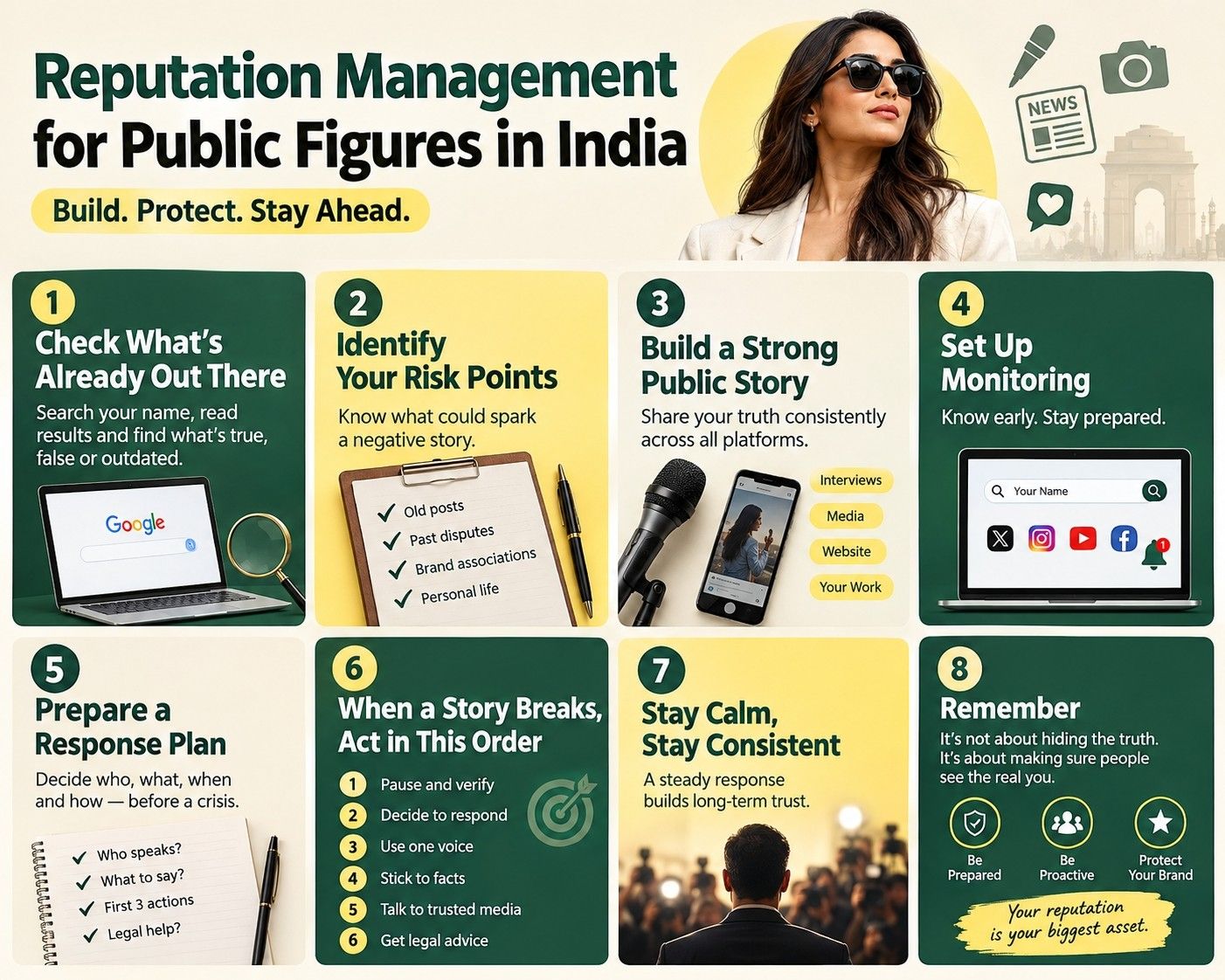
    Step 1: Find Out What Is Already Out There

    Search your own name on Google and on every major social platform. Read the first two pages of results. Check what appears in news searches, images and video. Note anything that is wrong, outdated or misleading, and anything that you wish were easier to find. You can’t manage a reputation you haven’t seen.

    Step 2: Identify Your Risk Points

    Every public figure has areas where a story could start. These include:

    • Old social media posts, interviews or comments that could be taken out of context.
    • Past disputes, contract issues or public disagreements.
    • Associations with brands, causes or people.
    • Anything in your work or personal life that the media may find interesting.

    Knowing these in advance means you can prepare, instead of being surprised.

    Step 3: Build a Strong, Accurate Public Story

    The best protection is a clear, positive and truthful public image that already exists. This comes from:

    • A consistent message across interviews, social media and public appearances.
    • Features, interviews and quotes in credible media.
    • A professional website or profile that you control and keep updated.
    • Work you do that supports your public positioning, such as causes, talks and projects.

    When a negative story appears, people judge it against what they already know about you.

    Professional public relations and media relations support can help public figures communicate their work, strengthen their positioning and build a credible public presence.

    Step 4: Set Up Monitoring

    You need to know quickly when something is being said about you. Set up alerts for your name on Google, follow mentions on social media, and decide who on your team checks them every day. Early warning gives you time to respond before a small issue grows.

    Step 5: Prepare a Response Plan Before You Need It

    A response plan answers the questions that are hard to answer in the middle of a crisis:

    • Who decides whether to respond, and who approves what is said?
    • Who speaks for you, and through which channel?
    • What are the first three actions in the first few hours?
    • When do you bring in a lawyer?
    • Which journalists and partners need to hear from you directly?

    Write it down and share it with your team, manager and agency.

    Step 6: When a Story Breaks, Act in This Order

    1. Pause and verify. Find out exactly what is being said, where it started and whether it is true.
    2. Decide whether to respond. Not every comment needs an answer. A response can sometimes make a small issue bigger.
    3. Use one voice. Share one clear statement through one channel, approved by the right people.
    4. Stick to facts. Correct what is wrong, accept what is right and avoid arguments.
    5. Talk to the media you trust. Journalists you have worked with are more likely to hear your side.
    6. Get legal advice when needed. If a story is false and harmful, consult a lawyer about your options, instead of reacting online.

    The right response depends on the facts and the seriousness of the situation. Verify the information before making public statements, and seek professional legal advice when necessary.

    Step 7: Recover and Rebuild

    Once the issue settles, return to your steady public story. Share your work, speak on topics you care about and keep showing up consistently. Trust returns through steady behaviour, not through a single statement.

    Continue monitoring your online presence and review your response plan after the situation has passed. Consistent, responsible communication helps you rebuild credibility over time.

    Common Mistakes Public Figures Make

    • Deleting and denying: Removing posts or denying facts can make a story worse if the truth comes out later.
    • Responding emotionally: An angry post written in the heat of the moment is often the one people remember.
    • Having several voices: Mixed messages from you, your team and friends make things confusing.
    • Waiting too long: Silence in the first hours lets others tell your story for you.
    • Fighting every critic: Engaging with trolls gives them more attention.
    • Starting only after a crisis: By then, the work you needed to do in advance is too late.

    How Sorta Famous Helps

    Sorta Famous is a PR and marketing agency based in Andheri, Mumbai, working with actors, TV stars, musicians, founders and entrepreneurs. We help public figures build a clear public story and protect it, with audit and positioning work first, followed by media relations and a reputation plan.

    Our approach combines public relations, media relations, brand management and personal branding to help public figures strengthen their visibility and public image.

    Support can be ongoing or project-based, without a long retainer, and you work directly with the strategists handling your case.

    If you want a plan in place before you need one, get in touch with Sorta Famous for a free 30-minute consultation.

    Frequently Asked Questions

    What Is Reputation Management for Public Figures?

    It is the work of building an accurate public image and protecting it. It includes a proactive strategy and a plan to respond
  • LinkedIn personal branding for founders in India

    LinkedIn personal branding for founders in India

    In India, a lot of business now gets decided on LinkedIn before anyone picks up the phone. Investors check a founder’s profile before a meeting. Clients look you up before they reply to your email. Candidates read your posts before they accept an offer. Journalists scroll through your profile before they say yes to an interview.

    For many people, your LinkedIn profile is the first thing they see about you, even before your website. This guide shows founders in India how to build a personal brand on LinkedIn that earns trust instead of just collecting connections.

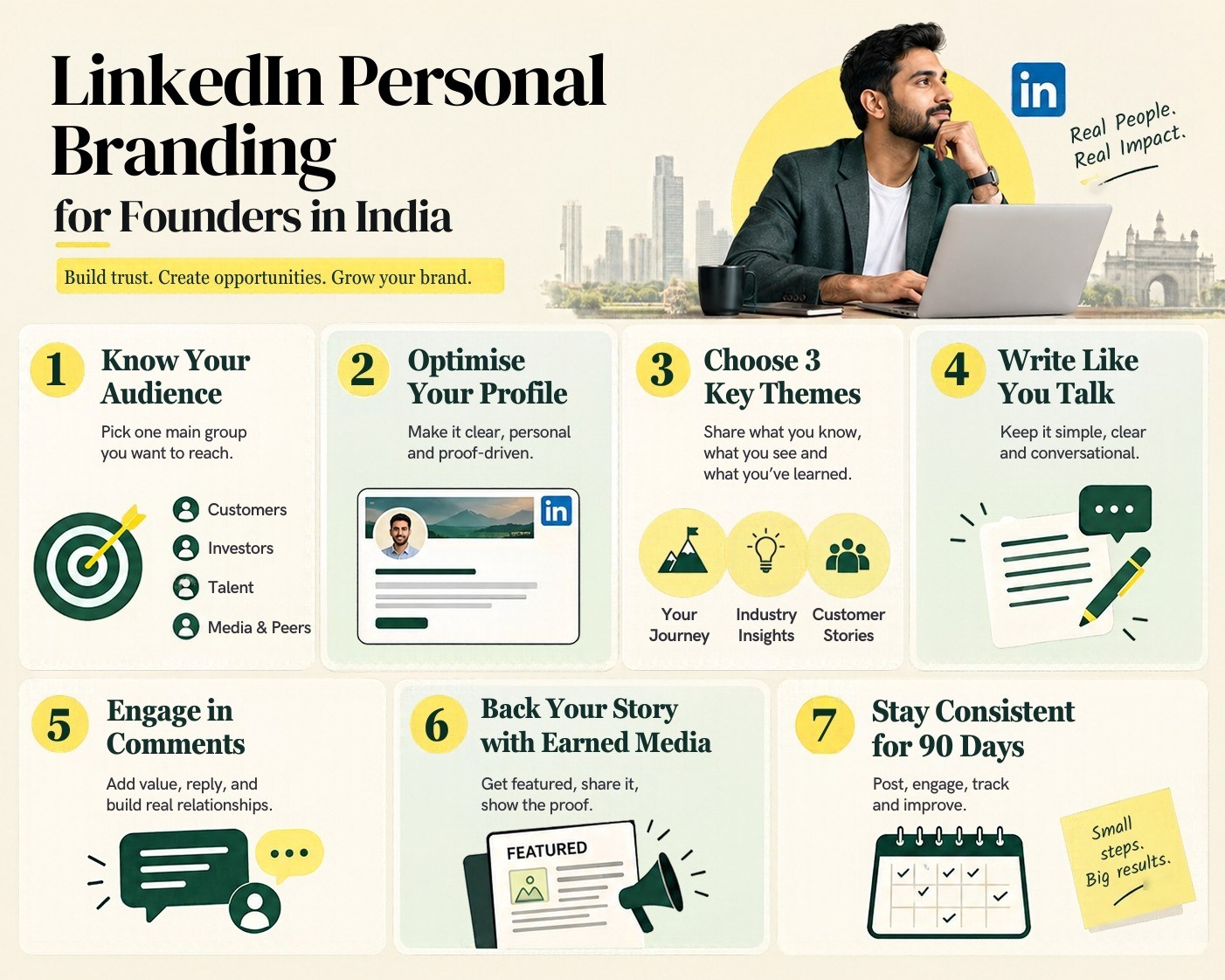
    Infographic showing the 7 steps of LinkedIn personal branding for founders in India, from choosing an audience to a 90 day review

    Why LinkedIn matters for founders in India

    A company page tells people what a business does. A founder’s profile tells them who is behind it. That difference matters, because people trust people. When a founder shares real thinking and real experience, the brand feels easier to believe, easier to approach and easier to remember.

    It also works quietly in the background. A strong profile helps with sales conversations, hiring, partnerships and press, all without extra advertising spend.

    Step 1: Decide who you want to reach

    You cannot speak to everyone at once. Choose one main audience for the next few months:

    • Customers: if you want leads and enquiries
    • Investors and partners: if credibility is the priority
    • Talent: if hiring is your biggest challenge
    • Media and industry peers: if visibility is the goal

    Everything else, from your headline to your post topics, follows from this choice.

    Step 2: Fix your profile before you post anything

    Posting from a weak profile wastes the attention you earn. Check these basics first:

    • Headline: say what you do and who you help, not just “Founder at [Company]”
    • Photo and banner: a clear, friendly photo and a banner that supports your message
    • About section: write in the first person, keep it short, and open with the problem you solve
    • Featured section: pin your best press features, case studies or talks as proof

    A good profile should answer one question in ten seconds: why should I pay attention to this person?

    Step 3: Choose three themes to talk about

    Themes keep your posting focused. Founders usually do well with a mix of:

    • Your journey: decisions, mistakes and lessons from building the business
    • Your industry view: honest opinions on what is changing in your space
    • Your customers: results, stories and what you have learned from them

    Stick to these for at least three months before changing direction. Repeating your themes is how people start to associate you with them.

    Step 4: Write the way you talk

    The best LinkedIn posts read like a clear conversation, not a corporate announcement. A few habits help:

    • Open with a first line that makes people want to keep reading
    • Keep sentences short and stay with one idea per post
    • Use plain words instead of industry jargon
    • Close with a question so people have an easy way to respond

    Text posts, carousels and short videos can all work. Choose the format you can create regularly without it feeling like a chore.

    Step 5: Spend time in the comments

    Posting is only half of LinkedIn. Fifteen minutes a day of thoughtful comments on other people’s posts can bring your profile more attention than another post of your own. Reply to every comment on your posts, and when you connect with someone new, add a short personal note explaining why.

    Step 6: Back your story with earned media

    What you say about yourself helps. What others say about you carries more weight. A feature in a publication, a quote in an industry article or a speaking invitation turns your own claims into outside proof. Share this coverage on your profile and pin the best pieces in your Featured section. This is where personal branding and PR work best together.

    Step 7: Stay consistent for 90 days, then review

    Pick a posting pace you can maintain, such as three posts a week, and keep it up for ninety days. Then look at what happened: new enquiries, better conversations, profile visits and who started following you. Keep what works and drop what does not.

    Infographic showing the 7 steps of LinkedIn personal branding for founders in India, from choosing an audience to a 90 day review

    Common mistakes founders make with LinkedIn

    • Treating the profile like an online CV. Your profile should speak to the people you want to reach, not list every job you have held.
    • Only posting company news. People follow founders for perspective, not only announcements.
    • Copying viral post formats. Borrowed styles often sound forced and do not fit your actual story.
    • Posting and disappearing. Without replies and conversations, posts rarely build a relationship.
    • Changing themes every few weeks. It is hard to be remembered for something that keeps shifting.
    • Ignoring press and proof. Third-party coverage is what moves a profile from self-promotion to credibility.

    How Sorta Famous helps founders build a personal brand

    Sorta Famous helps founders, entrepreneurs, actors, TV stars and musicians with personal brand building right from the start, by doing the positioning and audit work. This is followed by a media and content strategy that supports the chosen position. It includes media relations to secure the earned media that gives credibility to your brand, and reputation management to protect it. Support can be on an ongoing or project basis, without having to sign a retainer agreement for years.

    To start building your LinkedIn presence with a strategy behind it, get in touch with Sorta Famous for a free 30-minute consult.

    Frequently asked questions

    Why is LinkedIn important for founders in India?

    LinkedIn is where investors, clients, candidates and journalists often check you out before engaging. A strong founder profile builds trust in all of those conversations without any ad spend.

    How often should a founder post on LinkedIn?

    Two to three times a week is a good pace for most founders. Consistency matters more than volume, so choose a rhythm you can keep for months.

    What should a founder write in their LinkedIn headline?

    Say what you do and who you help in plain words. A headline that explains your value works better than a job title on its own.

    Should I post as myself or through my company page?

    Post mainly as yourself. Personal profiles tend to start more conversations, while the company page works best for official updates and hiring.

    How long does it take to build a personal brand on LinkedIn?

    Expect around three months of steady effort before you see clear signs, and longer for a strong reputation. The early signs are usually better conversations and relevant connection requests.

    Can PR help my LinkedIn personal brand?

    Yes. Press coverage and interviews give you outside proof to share and feature on your profile, which makes your personal brand more credible than self-published content alone.

  • How to build a personal brand as a celebrity in India

    How to build a personal brand as a celebrity in India

    There is a clear distinction between being known and being understood. Many actors, celebrities, singers in India have a lot of followers but no personal brand, as being followed says very little about who a person is. Personal brand is the difference between “I saw them in various shows” and “I completely get them”. The former becomes irrelevant with each new project, while the latter builds up over the years.

    Now, here is an actual guide on how to develop a personal brand, unlike the “be yourself” type of advice you will see all over the internet.

    Why personal branding matters more than ever for Indian celebrities

    The Indian entertainment industry has more entry points than ever before. From films to OTT to YouTube and podcasts, there has never been such fierce competition in all of them. One hit project used to be enough for a successful career for years. No more. The audiences and the brands today seek out celebrities with a personality, not necessarily a filmography.

    That is also why many celebrities seek new territories beyond acting or performing in any way. Personal brand building is key to make a credible step into entrepreneurship, health, investment, advocacy or anything else.

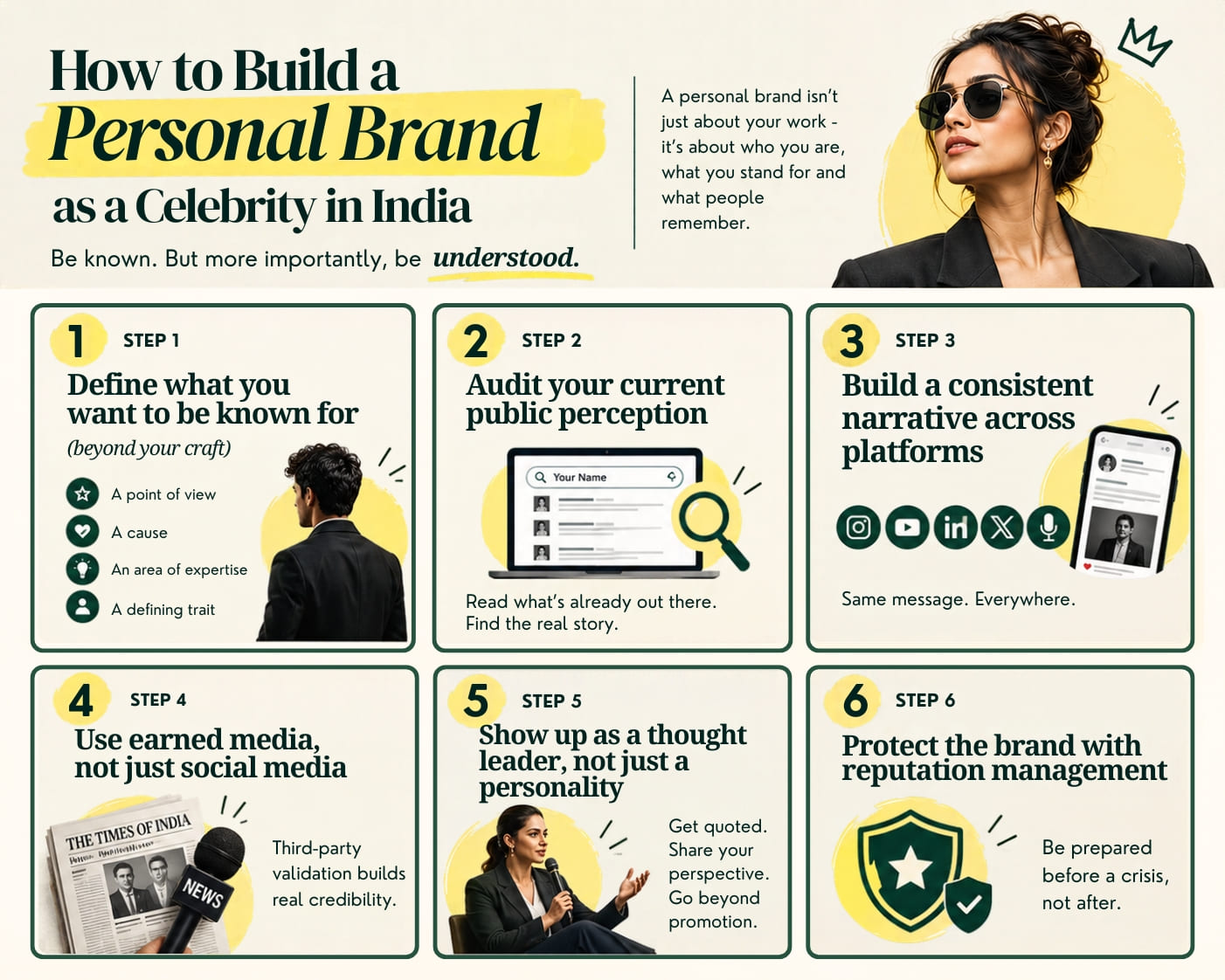
    Step 1: define what you want to be known for (beyond your craft)

    Before any press strategy or content plan, this has to be answered first: outside of acting, singing, or performing, what’s the thing people should associate with you? It could be a point of view, a cause, an area of expertise, or simply a consistent personality trait that comes through in every interview. Without this, every piece of press and content is disconnected from the last.

    Step 2: audit your current public perception

    Search your own name. Read what’s already been written. Look at your last ten interviews and ask what throughline actually exists in them. Most celebrities are surprised at how scattered their public image already is, a different angle in every piece, no consistent story tying it together. This audit is the starting point for everything that follows.

    Step 3: build a consistent narrative across every platform

    Once the positioning is clear, it has to show up the same way everywhere: interviews, social media bios and captions, LinkedIn if you’re building a business angle, even the questions you steer conversations toward on talk shows. Journalists and fans should be able to predict, in broad strokes, what you’re going to say about a topic before you say it. That predictability is what makes a brand feel real instead of manufactured.

    Step 4: use earned media, not just social media

    A personal Instagram post says what you want people to think. A feature in a national publication or a quote picked up by an entertainment desk carries far more weight, because it’s a third party validating the story, not just you telling it. This is where PR and personal branding intersect directly: press coverage, thought leadership pieces, and interviews are what turn a self-described identity into a publicly recognised one.

    Step 5: show up as a thought leader, not just a personality

    The celebrities who build the strongest personal brands eventually get quoted on topics outside their immediate work, industry trends, causes they care about, business decisions they’ve made. That only happens if you’re actively positioned for it: pitched for panels, approached for opinion pieces, made available for the kind of interview that goes beyond promotion.

    Step 6: protect the brand with reputation management

    A personal brand takes years to build and one bad news cycle to damage. Misquotes, out-of-context clips, and manufactured controversy move fast on social media. Part of building a personal brand is having a plan in place before any of that happens, not scrambling to respond after it’s already spread.

    build-celebrity-personal-brand-india

    Common mistakes Indian celebrities make with personal branding

    • Treating it as a social media task. Personal branding is a media and narrative strategy. Social content is one output of it, not the whole thing.
    • Changing the narrative every few months. Chasing whatever trend or cause is currently getting attention instead of staying consistent erodes credibility rather than building it.
    • Waiting until a crisis to think about reputation. By the time damage control is needed, it’s already reactive instead of planned.
    • Doing it without press support. Self-published content can only go so far. Third-party media coverage is what makes a personal brand credible rather than self-promotional.

    How Sorta Famous helps

    Sorta Famous helps actors, TV stars, musicians and entrepreneurs with personal brand building right from the start, by doing the positioning and audit work. This is followed by a media and content strategy that supports the chosen position. This includes media relations to secure the earned media that will provide credibility to your brand and reputation management to protect it. Assistance can be provided on ongoing or project basis, without having to sign a retainer agreement for years.

    To begin building your personal brand with a strategy behind it, contact Sorta Famous for a 30 minutes consultation.

    Frequently asked questions

    What does personal branding actually mean for a celebrity?

    That requires you to have a consistent identity in everything outside of your acting career, including media, interviews, and public appearances, which will help people and brands figure out who you are and what you are about, not just what shows you have been in.

    How is personal branding different from PR?

    PR is one of the tools used to build a personal brand. It covers the media relationships and press coverage that give a personal brand external credibility. Personal branding is the broader positioning and narrative strategy that PR, social media, and public appearances all support.

    How long does it take to build a recognisable personal brand?

    There is no fixed timeline, but it is a long-term effort. The positioning and audit work can be done in a few weeks, while consistent press coverage and a narrative people actually recognise usually take several months to a year or more of sustained work.

    Do I need to be a public figure already to start building a personal brand?

    No. In personal branding, timing matters greatly. It is important that personal branding happens right from the beginning because the brand would already be formed in the audience’s eyes in relation to the event or position that made the person well known.

    Can personal branding help with brand endorsements and business opportunities?

    Yes. Brands tend to opt for those personalities who have a distinct identity, for that adds credibility to the connection and lowers the chances of forming a mismatched one.

    What if I already have a strong following but no clear personal brand?

    This is true. In most cases, having a large following without a distinctive voice implies that the audience is familiar with the personality but not with what he or she stands for. An assessment of the brand perception of the celebrity is the starting point of solving the problem.

    Is personal branding just about looking good in the media?

    No. It is about maintaining consistency and having an actual point of view.