Tag: Content Strategy

  • Social Media Marketing Agency in Mumbai: How to Choose One

    Social Media Marketing Agency in Mumbai: How to Choose One

    Mumbai has no shortage of social media agencies. There are solo freelancers working from home, small boutique studios, full-service marketing firms and large network agencies. They all promise growth, engagement and reach. What they actually deliver can be very different.

    This guide helps you choose a social media marketing agency in Mumbai that fits your business, your budget and your goals, without learning the hard way.

    What a Social Media Marketing Agency Does

    A good agency handles more than posting. Depending on what you need, it may cover:

    • Strategy: Deciding which platforms, topics and tone will work for your audience.
    • Content creation: Designing posts, shooting and editing videos, and writing captions.
    • Community management: Replying to comments and messages in your brand’s voice.
    • Paid campaigns: Running and optimising ads on Meta and other platforms.
    • Influencer and creator collaborations: Finding and managing the right partnerships.
    • Reporting: Showing what worked and what to do next.

    Before you start talking to agencies, decide which of these services you need. It makes comparing them much easier.

    Which Type of Agency Suits You?

    • Freelancers: Flexible and affordable, good for simple needs, but limited by one person’s time and skills.
    • Boutique agencies: Focused teams with senior attention, often a good fit for small and mid-sized businesses.
    • Full-service agencies: A wide range of services under one roof, useful when you need PR, advertising and content marketing together.
    • Large network agencies: Deep resources, usually built for large brands and larger budgets.

    There is no single best type. The right one is the agency that matches your business size, goals, budget and how closely you want to work with the people doing the job.
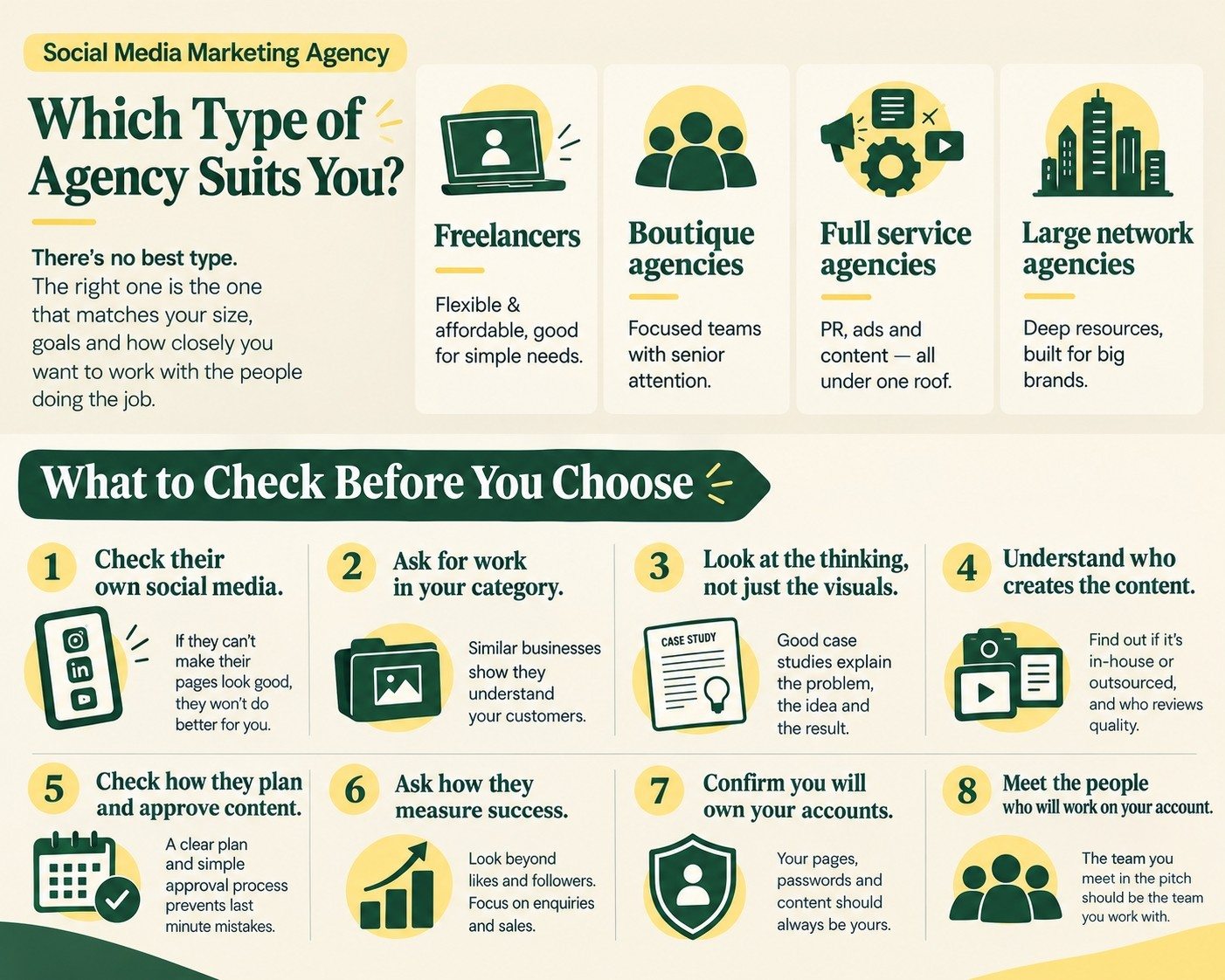
    Checklist infographic for choosing a social media marketing agency, covering strategy, portfolio, content planning, reporting, account ownership and contract terms

    What to Check Before You Choose

    1. Look at Their Own Social Media

    An agency’s own social media profiles can tell you something about its approach to content, branding and consistency. Review the quality of its posts, the tone of its communication and how it engages with its audience.

    Use this as one indicator rather than the only measure of its capabilities. Ask to see actual client work and results before making a decision.

    2. Ask for Work in Your Category

    Ask for examples of campaigns for businesses similar to yours. Relevant experience can help an agency understand your customers, competitors and industry challenges.

    Look beyond the visuals and ask what the campaign was designed to achieve.

    3. Look at the Thinking, Not Just the Visuals

    Good case studies explain the problem, the idea, the strategy and the result. Attractive posts alone do not prove that an agency can help your business grow.

    Ask how its content strategy connects to your objectives, whether that means building awareness, generating enquiries, increasing website traffic or driving sales.

    4. Understand Who Creates the Content

    Find out whether design, video production and writing are handled by the agency’s own team or outsourced. Ask who reviews the work, manages revisions and ensures quality.

    You should know who is responsible for your content and who to contact when you need changes.

    5. Check How They Plan and Approve Content

    A clear monthly content plan and a simple approval process help prevent last-minute mistakes. Ask when you will receive the content calendar, how approvals work and how many revisions are included.

    Make sure the process is practical for your team and that deadlines and responsibilities are clearly defined.

    6. Ask How They Measure Success

    Good agencies track business signals such as enquiries and sales, not only likes and followers. Depending on your goals, useful metrics may include:

    • Reach and brand awareness.
    • Engagement and audience quality.
    • Website traffic and enquiries.
    • Qualified leads and conversions.
    • Sales and advertising performance, where applicable.

    Ask how often the agency shares reports and how it uses performance data to improve future campaigns. If paid campaigns are important to your business, explore performance marketing services that focus on measurable outcomes.

    7. Confirm You Will Own Your Accounts

    Your business should retain ownership and appropriate administrator access to its social media pages, advertising accounts, analytics and content assets.

    Make sure access permissions are set up securely and that your agreement explains what happens to accounts, files and campaign data if the contract ends.

    8. Meet the People Who Will Work on Your Account

    The team presenting the pitch should be the team you work with. Ask to meet the people responsible for strategy, content creation and day-to-day account management.

    Direct communication with the right people can make collaboration easier and help prevent misunderstandings.

    Red Flags to Watch Out For

    • Promising a specific number of followers: Genuine growth cannot be guaranteed, and fake followers can harm your brand’s credibility.
    • No clear strategy: If the plan is just a posting schedule, you are buying content production rather than a complete marketing approach.
    • No access to your analytics: You should be able to access your accounts and review your own performance data.
    • Long lock-ins with no way out: Understand the cancellation terms before signing. A good agency earns its renewals by delivering value.
    • Copying what other brands do: Your content should be built around your own business, customers and positioning.

    Questions to Ask in Your First Meeting

    Before hiring a social media marketing agency in Mumbai, ask these questions:

    • What would you do differently for our business compared with other brands?
    • Who will run our account day to day?
    • How many revisions and approvals are part of the process?
    • How will you report results, and how often?
    • What do you need from us each month?
    • What happens if we want to stop working together?

    The answers will help you understand how the agency works, what it expects from your team and whether its process fits your business.

    How Long Before You See Results?

    Social media usually takes a few months to show clear results, although the timeline depends on your industry, audience, budget and objectives.

    Early signs of progress may include better-quality enquiries, more replies, steadier engagement and increased interest in your business. Paid campaigns may generate initial data sooner, but consistent optimisation is still important.

    Be cautious of anyone promising overnight growth or guaranteed business results. Focus on measurable progress and whether your social media activity is contributing to your wider business goals.

    How Sorta Famous Helps

    Sorta Famous is a PR and marketing agency based in Andheri, Mumbai. Social media marketing is one of the services we offer, alongside public relations (PR), brand management, personal branding and performance marketing.

    This integrated approach helps your social media presence work together with your press coverage, brand identity and reputation.

    Every engagement starts with an in-depth audit of your current presence and what you want to achieve. From there, the strategy is shaped around your business and its objectives.

    Support can be project-based, with no long-term retainer, and you work directly with the strategists handling your account.

    If you are comparing agencies and want a straightforward conversation about what you need, get in touch with Sorta Famous to enquire about a free 30-minute consultation.

    Frequently Asked Questions

    What does a social media marketing agency do?

    It plans and manages your social media presence. This can include strategy, content creation, community management, paid advertising, creator partnerships and performance reporting.

    How do I choose a social media agency in Mumbai?

    Look at its own social media profiles, ask for relevant work, understand who creates your content, check how results are reported and confirm that you will retain ownership of your accounts.

    Should I hire a freelancer or an agency?

    A freelancer can work well for simple requirements and smaller budgets. An agency may suit you better when you need strategy, a team of specialists and several marketing services working together.

    Do social media agencies guarantee followers?

    Be cautious of agencies that guarantee specific follower counts. Followers can be purchased, but they do not necessarily bring customers and can hurt your credibility. Focus on genuine engagement, relevant audiences and business results.

    How long should I commit to an agency?

    Start with a clear scope of work and review results regularly. Understand the cancellation terms before signing, and be careful about long lock-ins before you have evaluated the agency’s work.

    Who owns my social media accounts?

    You should. Retain ownership and administrator access to your accounts, and make sure your contract clearly explains ownership of accounts, content and campaign data.
  • Instagram content calendar for small businesses

    Instagram content calendar for small businesses

    Most small businesses don’t struggle with Instagram because they have nothing to say. They struggle because every morning starts with the same question: what do we post today? Some days the answer is a rushed festival greeting. Some days it is nothing at all. After a few weeks, the page goes quiet.

    An Instagram content calendar fixes this. It is a simple plan that shows what you will post, when and why. This guide shows you how to build one for a small business in India, with a template you can copy.

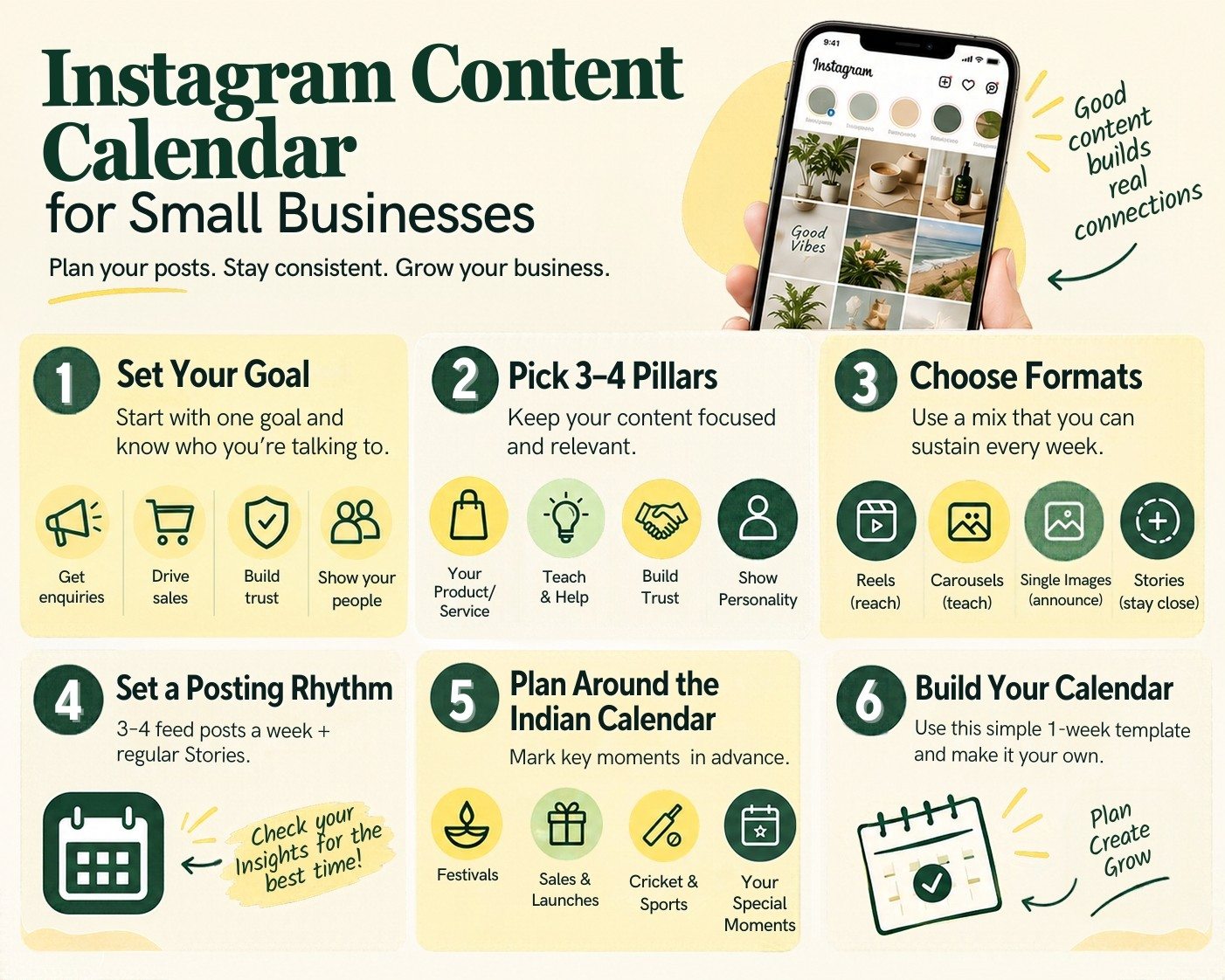
    Infographic showing the 8 steps to build an Instagram content calendar for a small business in India, from setting a goal to a monthly review

    Why a content calendar works

    A content calendar does three things for a small business:

    • It keeps you consistent. Regular posting matters more than occasional bursts of effort.
    • It removes daily stress. You decide once, instead of every morning.
    • It connects your posts to your goals. Every post has a purpose, so your page doesn’t turn into a random mix of images.

    Step 1: Decide what Instagram is for

    Start with one goal. It could be getting enquiries, selling a product, building trust, or showing the people behind the business. Also decide who you are talking to. A calendar built for young shoppers will look different from one built for business owners.

    Step 2: Choose 3 to 4 content pillars

    Content pillars are the main topics you post about again and again. For a small business, a simple mix works well:

    • Show your product or service: what you offer and how it works
    • Teach something useful: tips, how tos and answers to common questions
    • Build trust: customer stories, reviews and behind the scenes moments
    • Show personality: your team, your story and your values

    Every post should fit into one of these pillars. If it doesn’t, ask whether it needs to be posted at all.

    Step 3: Pick the formats you can sustain

    Instagram offers several formats, and each does a different job:

    • Reels: short videos that can reach people who don’t follow you yet
    • Carousels: swipeable posts that work well for tips, steps and comparisons
    • Single images: good for announcements, offers and product highlights
    • Stories: daily, casual updates that keep followers close

    Choose the mix you can actually produce every week. Two good Reels a week are better than five rushed ones you stop making.

    Step 4: Set a posting rhythm

    For most small businesses, three to four feed posts a week plus regular Stories is a realistic starting point. Check your Instagram Insights to see when your followers are most active, and schedule your posts around those times.

    Step 5: Plan around the Indian calendar

    Indian businesses have a calendar of moments that customers care about. Mark these in advance so you are not scrambling at the last minute:

    • Major festivals such as Diwali, Navratri, Ganesh Chaturthi, Holi, Raksha Bandhan, Eid and Christmas
    • Wedding and gifting seasons
    • Cricket seasons and big sporting events
    • Your own moments, such as sales, launches and anniversaries

    Plan these posts a few weeks ahead, and keep the rest of the calendar flexible.

    Step 6: Build your calendar

    Here is a simple one week template. Copy it, and swap the ideas for your own business.

    Day Format Pillar Example idea
    Monday Carousel Teach something useful 5 tips related to your product or service
    Tuesday Stories Build trust Behind the scenes of today’s work
    Wednesday Reel Show your product or service A 30 second demo of how it works
    Thursday Stories Teach something useful Question box or poll on a common customer doubt
    Friday Single image Build trust A customer review or testimonial
    Saturday Reel Show personality Meet the team or the story behind the business
    Sunday Rest and plan None Reply to comments and DMs, and plan next week

    Copy the same layout into a spreadsheet or a planner, and extend it to four weeks.

    Step 7: Batch your work and schedule it

    Set aside one block each week, or each month, to shoot photos and videos, write captions and schedule posts. Batching saves time and keeps the quality steady. Keep a running note of ideas from customer questions and daily work so you never start from a blank page.

    Step 8: Review every month

    At the end of each month, look at which posts brought the most saves, shares, DMs and enquiries. Do more of what worked and drop what didn’t. A calendar is not fixed. It improves each month.

    Common mistakes with Instagram calendars

    • Planning too much. A calendar you can’t keep is worse than a simple one you can.
    • Only posting offers. People get bored of constant selling.
    • Ignoring comments and DMs. Posting is half the work. Replies build relationships.
    • Copying trends that don’t fit. Not every trending sound or format suits your brand.
    • Never reviewing results. Without a monthly check, you repeat the same mistakes.

    How Sorta Famous helps

    Sorta Famous is a PR and marketing agency based in Andheri, Mumbai, that helps small businesses and brands build social media presence with a clear strategy behind it. We start with an audit of what you already have and what you want to achieve, then plan content that fits your brand and your calendar, not a generic template. Support can be project-based, with no long-term retainer, and you work directly with the strategists on your account.

    If you want a content plan built for your business, get in touch with Sorta Famous for a free 30-minute consult.

    Frequently asked questions

    How many times a week should a small business post on Instagram?

    Three to four feed posts a week plus regular Stories is a good starting point. Choose a pace you can keep for months.

    How far ahead should I plan my content calendar?

    Plan the next month in detail, and mark major festivals and sales a few months ahead.

    What should I post on Instagram for my small business?

    A mix of your products, useful tips, customer proof and glimpses of your team. Use the content pillars in this guide to keep the mix balanced.

    Should I use Reels or regular posts?

    Both. Reels help new people find you, while carousels and images help existing followers understand and trust you.

    What is the best time to post on Instagram in India?

    It depends on your audience. Check your Instagram Insights to see when your followers are most active, then post around those times.

    Do I need a tool to schedule my posts?

    Not necessarily. You can schedule posts within Instagram, or use a free planner or spreadsheet to track your calendar.

  • Performance marketing for small businesses in India

    Performance marketing for small businesses in India

    Every small business owner has been there. You put some money into ads, a few likes come in, maybe a couple of enquiries, and then you are left wondering what the money actually did. Performance marketing exists to remove that guesswork. You pay for results you can measure, and you can see exactly what each rupee brought back.

    This guide explains performance marketing for small businesses in India in plain words, with steps you can follow whether you run the ads yourself or work with an agency.

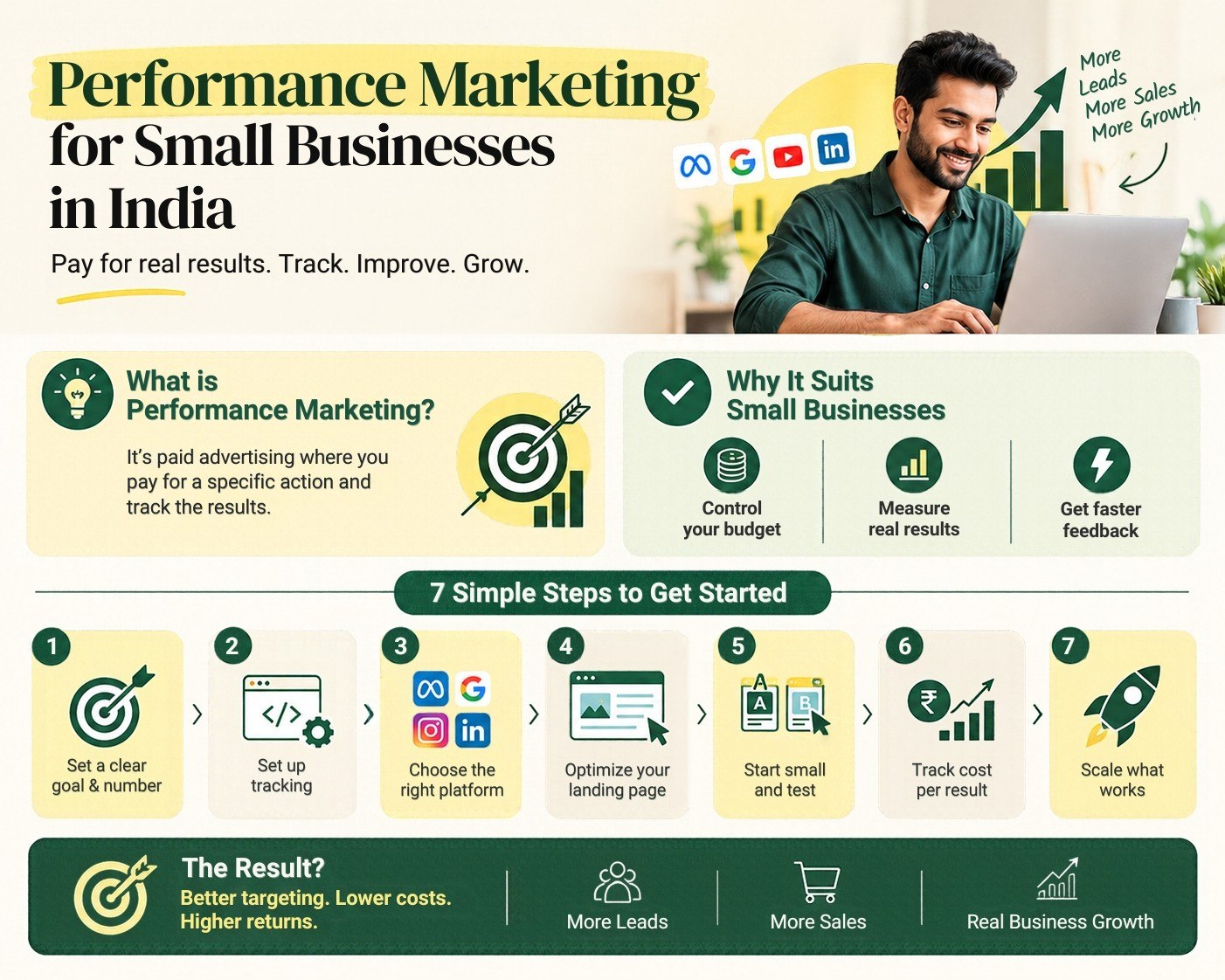
    Infographic showing the 7 steps of performance marketing for small businesses in India, from setting a goal to scaling what works

    What is performance marketing?

    Performance marketing is paid advertising where you pay for a specific action and track it closely. That action could be a click, a form fill, a phone call, an app install or a sale. Instead of paying for exposure and hoping for the best, you pay for outcomes and use the data to decide where your money should go next.

    The most common places to run it in India are Meta (Facebook and Instagram), Google Search and YouTube, and LinkedIn for B2B businesses.

    Why it suits small businesses

    Performance marketing works well for small businesses for three reasons:

    • You control the budget. You can start small and increase spend only when something works.
    • You can measure results. Reports show which ad, audience and message brought leads or sales.
    • You get faster feedback. You can learn in days what organic content might take months to show.

    The catch is that it needs a clear goal and proper tracking. Without them, ads become an expense instead of an investment.

    Step 1: Set one clear goal and a number

    Decide exactly what you want from your ads. More leads, more sales, more calls or more app installs? Then put a number on it. Work out how much a lead or sale is worth to your business and how much you can afford to pay to get one. Without this number, you cannot tell if your campaigns are working.

    Step 2: Set up tracking before you spend

    This is the step most small businesses skip, and it is the most important. Before running any ads:

    • Install the ad platform’s tracking code on your website, such as the Meta Pixel
    • Set up website analytics so you can see how visitors behave
    • Define the actions you want to count, such as form submissions, calls or purchases
    • Use tagged links so you know which ad each visitor came from

    If your tracking is broken, every decision after this is a guess.

    Step 3: Choose the right platform

    Different platforms catch people at different moments:

    • Google Search: reaches people who are already looking for what you sell, so it suits services and high intent products
    • Meta (Facebook and Instagram): helps you reach people who have not heard of you yet, and works well for visual and consumer products
    • LinkedIn: suits B2B businesses that want to reach decision makers, though it is usually more expensive

    Start with one platform that matches how your customers find businesses like yours.

    Step 4: Fix your landing page first

    Ads only bring people to your door. The page they land on decides whether they act. Check that your landing page:

    • Loads quickly on a mobile phone
    • Says clearly what you offer and who it is for
    • Has one main action, such as a form, a call button or a WhatsApp link
    • Shows proof like reviews, client names or press coverage

    A great ad sending people to a confusing page wastes the money you spent to get them there.

    Step 5: Start small and test

    Begin with a small daily budget you are comfortable with, and test two or three different ads against each other. Change one thing at a time, such as the headline, the image or the offer. Give each test a few days to run before judging it, because ad platforms need time to learn who responds best.

    Step 6: Track cost per result, not likes

    Likes and clicks feel good but they do not pay your bills. Watch the numbers that connect to your goal: cost per lead, cost per sale and the revenue you earn for each rupee spent. An ad with fewer likes and a lower cost per lead is the better ad.

    Step 7: Scale what works and stop what does not

    Once an ad is clearly working, increase its budget gradually and keep testing new versions. Turn off the ones that are not working. You can also run retargeting ads that show up only to people who visited your site or engaged with your content, since they already know you.

    How performance marketing and brand building work together

    Performance marketing is very good at capturing people who are ready to act. Brand building is what makes more people ready to act in the first place. A business with a trusted brand usually gets better results from the same ad spend, because people recognise the name and feel safer clicking. The strongest small businesses do both.

    Common mistakes small businesses make with performance marketing

    • Boosting posts without a goal. A boosted post with no clear objective rarely brings useful results.
    • Spending before tracking is set up. You cannot improve what you cannot measure.
    • Sending traffic to the homepage. A focused landing page almost always does better.
    • Judging results after one day. Platforms need a few days to learn and settle.
    • Changing everything at once. If you change many things, you will never know what made the difference.
    • Watching likes instead of leads. Engagement is not the same as business results.

    How Sorta Famous helps with performance marketing

    Sorta Famous is a Mumbai-based PR and marketing agency that helps brands grow with strategy behind every rupee. All of our engagements start with an in-depth audit of your current visibility and goals, followed by a plan built around your calendar and not a generic campaign template. We also give project-based support without a long-term retainer, for businesses that need a focused push around a launch or season. And there are no account managers in between. You work directly with the strategists running your campaign.

    To start running ads with clear tracking and a clear goal, get in touch with Sorta Famous for a free 30-minute consult.

    Frequently asked questions

    What is performance marketing in simple words?

    It is paid advertising where you pay for a measurable action, such as a lead or a sale, and track the results so you know exactly what your money is doing.

    Is performance marketing good for small businesses in India?

    Yes. You can start with a small budget, measure every result and grow spending only when something works, which makes it a practical choice for small businesses.

    What is the difference between performance marketing and digital marketing?

    Digital marketing is the broad term for all online marketing, including content, SEO and social media. Performance marketing is the part focused on paid campaigns where results are tracked and paid for.

    Which platform is best for performance marketing?

    It depends on your customer. Google Search suits people who are already looking for what you sell, Meta suits discovery and consumer products, and LinkedIn suits B2B.

    How long does it take to see results from performance marketing?

    You can get early data within a few days, but it usually takes a few weeks of testing to find what works and improve your cost per result.

    Do I need a big budget to start?

    No. Start with a small amount, test carefully and increase spending only on what is working. A clear goal and proper tracking matter more than a big budget.

  • Brand management for small businesses in India

    Brand management for small businesses in India

    Many small business owners think a brand is a logo and a colour palette. Then a customer finds them on Google, sees a different look on Instagram, gets a rushed reply on WhatsApp and a plain invoice by email, and quietly wonders if it is the same business. That gap is exactly what brand management is meant to close.

    Here is a simple guide to brand management for small businesses in India, with steps you can start on without a big team or budget.

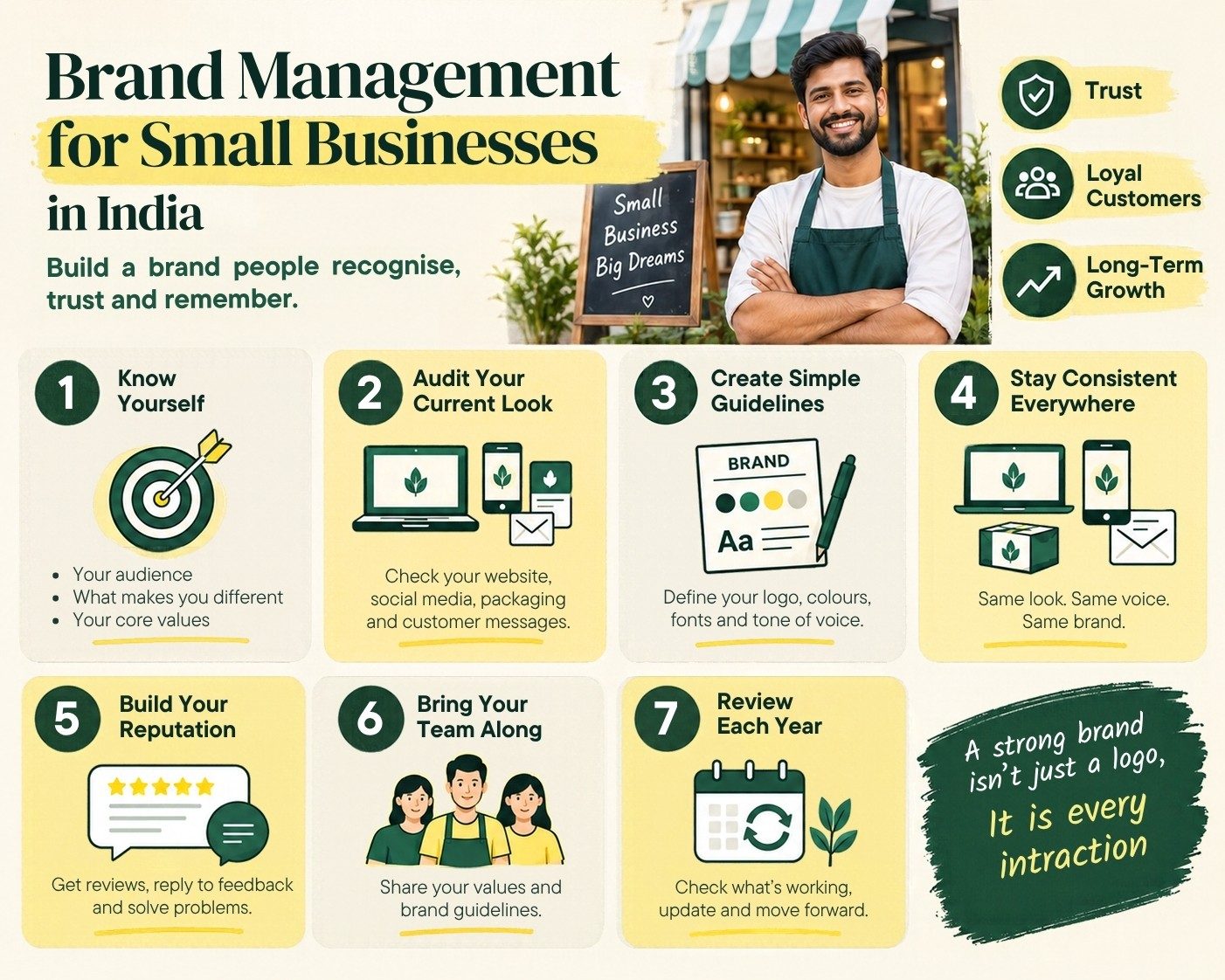
    Infographic showing the 7 steps of brand management for small businesses in India, from defining who you are to an annual review

    What is brand management?

    Brand management is the ongoing work of shaping how people see your business. It covers your name, your look, the way you talk, how you treat customers and what people say about you when you are not in the room. A logo is one small part of it. The bigger part is whether every experience a customer has with you feels like it came from the same business.

    Why small businesses in India need it

    Customers in India have more choice than ever, and they compare quickly. Before they buy, they check your website, scroll your social pages, read your Google reviews and often ask someone they know. A business that looks and sounds consistent feels safer to buy from.

    Brand management also protects you as you grow. When your identity is clear, new team members, designers and partners can represent you correctly without asking you every time.

    Step 1: Define who you are

    Before touching a logo or a colour, answer a few plain questions:

    • Who exactly are you trying to serve?
    • What do you do better or differently than the alternatives?
    • What do you want customers to say about you after they have worked with you?
    • Which three words describe your business at its best?

    Write the answers down in a short paragraph. This becomes the foundation for every brand decision that follows.

    Step 2: Audit how you look and sound today

    Most small businesses are surprised by how inconsistent they already are. Look at every place a customer meets your brand:

    • Your website and Google Business Profile
    • Your social media pages and bios
    • Packaging, invoices, brochures and visiting cards
    • How you and your team reply on calls, email and WhatsApp

    Note where the look, tone or message changes from one place to another. These are the first things to fix.

    Step 3: Create simple brand guidelines

    You don’t need a fifty page document. A single page is enough to start. Include:

    • Your logo and how it should and should not be used
    • Two or three brand colours and one or two fonts
    • Your tone of voice, for example warm and direct, or formal and precise
    • Words and phrases you use, and ones you avoid

    Share this page with everyone who creates anything on your behalf.

    Step 4: Stay consistent at every touchpoint

    Consistency is where most of the value of a brand comes from. Use the same name, the same look and the same way of speaking on your website, your social media, your packaging and your customer messages. People should be able to recognise you even without seeing your logo.

    Step 5: Look after your reputation

    Your reputation is part of your brand, and it is built in small moments:

    • Ask happy customers for Google reviews and thank them when they leave one
    • Reply to complaints calmly and quickly, in public and in private
    • Keep your business details accurate everywhere they appear online
    • Fix the root cause of repeated complaints instead of only apologising

    How you handle a problem often shapes opinion more than how you handle a good day.

    Step 6: Bring your team along

    Every person who talks to a customer is representing your brand. Take half an hour to walk your team through your one page guidelines, explain what the business stands for and show them how to handle common situations in your voice. A brand that only the owner understands will not stay consistent for long.

    Step 7: Review once a year

    Businesses change. New products, new customers and new competitors can all make your brand feel out of date. Once a year, repeat the audit from Step 2, update your guidelines and fix whatever has drifted.

    Infographic showing the 7 steps of brand management for small businesses in India, from defining who you are to an annual review

    Common mistakes small businesses make with branding

    • Treating a logo as the whole brand. A good logo cannot fix an inconsistent customer experience.
    • Changing the look every few months. Constant changes stop people from recognising you.
    • Trying to appeal to everyone. A clear audience makes your message stronger.
    • Different tone on every platform. Customers should not feel they are speaking to different businesses.
    • Ignoring reviews and complaints. Public silence reads as a lack of care.
    • Leaving branding to one person. If it only lives in someone’s head, it disappears when they are busy or leave.

    How Sorta Famous helps with brand management

    Sorta Famous is a Mumbai-based PR and marketing agency that helps businesses build brands people recognise and trust. All of our engagements start with an in-depth audit of your current visibility and goals, followed by a strategy built around your calendar and not a generic content plan. This includes positioning work, media relations to earn outside credibility, and reputation management to protect what you build. We also give project-based support without a long-term retainer, and there are no account managers in between. You work directly with the strategists running your campaign.

    To start building a brand with a strategy behind it, get in touch with Sorta Famous for a free 30-minute consult.

    Frequently asked questions

    What is brand management in simple words?

    It is the ongoing work of shaping how people see your business, through your name, look, voice, customer experience and reputation, so that everything feels consistent.

    Is brand management only for big companies?

    No. Small businesses often benefit the most, because a clear and consistent brand helps them stand out against larger competitors without a large marketing budget.

    What is the difference between branding and marketing?

    Branding is who you are and how you are perceived. Marketing is how you get that message in front of people. Strong marketing works much better on top of a clear brand.

    How much does brand management cost?

    It depends on the scope. You can start for free with a simple audit and a one page guideline, and bring in an agency when you need positioning, press and reputation support.

    How long does it take to build a brand?

    The basics can be set in a few weeks. A strong reputation takes much longer, because it is built through consistent experiences over months and years.

    Do I need a designer for brand guidelines?

    A designer helps with the logo, colours and fonts, but the most important parts, such as your positioning and tone of voice, come from you and can be written down without one.

  • Social media strategy for founders in India

    Social media strategy for founders in India

    Most founders fall into one of two traps on social media. Either they post nothing because there is no time, or they post everything with no direction and wonder why nothing comes back. Neither is a strategy. A strategy is simply a set of clear choices: where you show up, what you say, how often, and what you want out of it.

    This guide breaks down a social media strategy for founders in India that you can actually follow while running a business.

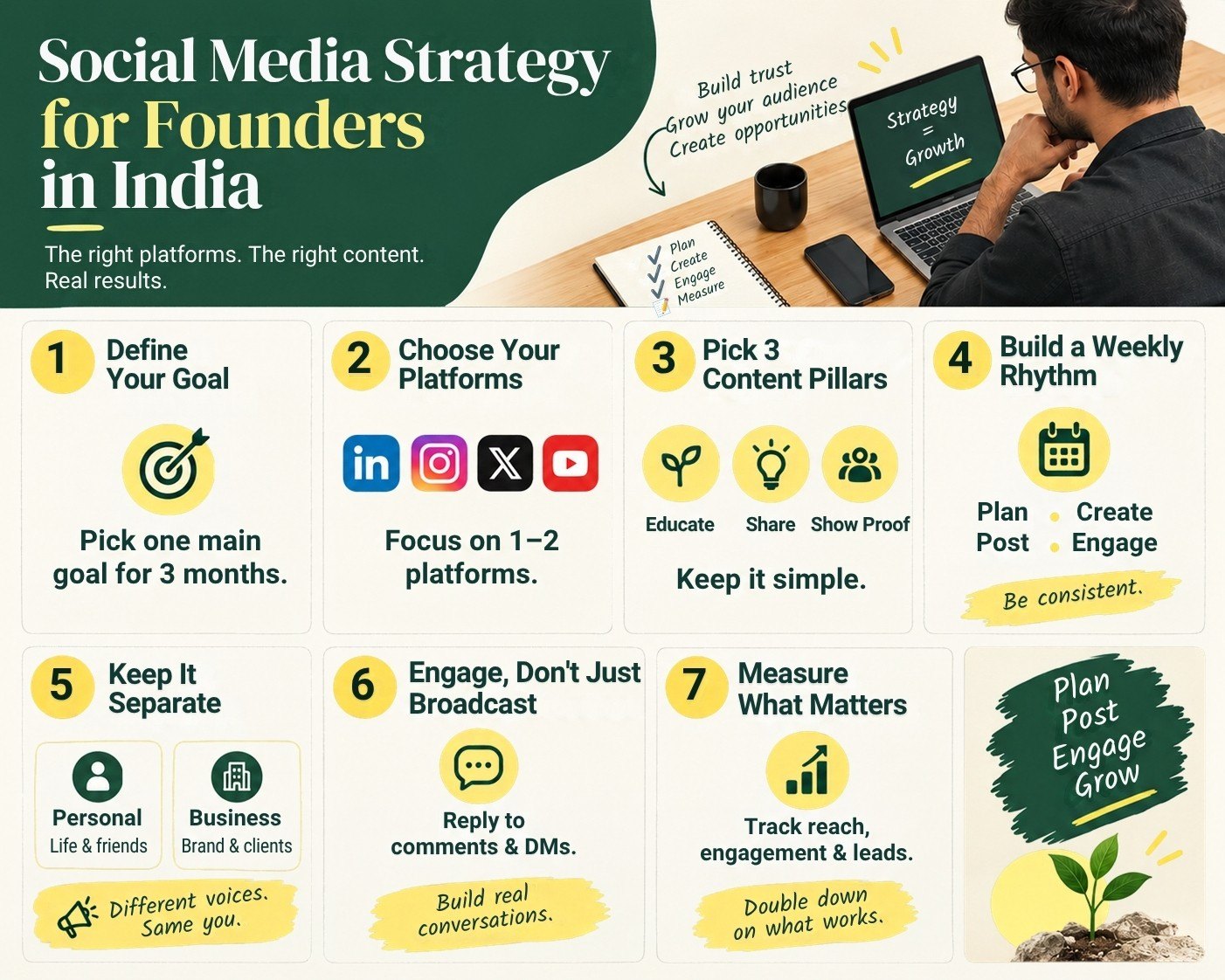
    Infographic showing the 7 steps of a social media strategy for founders in India, from setting a goal to measuring results

    Why founders need a social media strategy of their own

    People connect with people far more easily than they connect with logos. A founder who shares how they think, what they are building and what they have learned gives customers, investors and future hires a reason to trust the brand before they ever speak to anyone.

    That trust has real uses. It brings in enquiries, makes hiring easier, opens doors to journalists and helps investors feel they already know you. But it only works when it is planned. Random posting, however well meant, rarely builds anything.

    Step 1: Decide what you want social media to do for you

    Pick one main goal for the next three months. It could be:

    • Getting more customers or enquiries
    • Attracting good people to work with you
    • Building credibility with investors or partners
    • Getting noticed by journalists and industry events

    You can benefit from all of these over time, but your first goal decides what you post and where. A founder who wants B2B leads posts very differently from one who wants to sell a consumer product.

    Step 2: Choose one or two platforms, not five

    Trying to be everywhere is the fastest way to burn out. Match the platform to your goal and your audience:

    • LinkedIn: best for B2B, hiring, investors and professional credibility
    • Instagram: best for consumer brands, visual products and behind-the-scenes stories
    • X: useful for startup, tech and media communities that talk in real time
    • YouTube: strong for long-form explanations and building depth over time

    Start with one platform and do it well for at least three months before adding another.

    Step 3: Pick three content pillars

    Content pillars are the three topics you come back to again and again. They remove the daily “what do I post” problem. A simple set for founders:

    • The building story: decisions, mistakes, milestones and what you are learning
    • Your expertise: practical lessons from your industry that help your audience
    • Proof: customer stories, results and real moments from the business

    Mix these through the week so your profile feels useful and human, not only promotional.

    Step 4: Build a weekly rhythm you can keep

    Consistency beats intensity. Three good posts a week that you can sustain are better than a daily burst that stops after a month. A simple routine:

    • Set aside one block each week to plan and write the week’s posts
    • Keep a running note of ideas from meetings, customer calls and conversations
    • Batch your writing so posting never depends on your mood that day

    Step 5: Run your personal profile and company page differently

    Your personal profile and your company page do different jobs. The personal profile is where trust and conversation happen. The company page is the official home for announcements, hiring and proof. Make sure both tell the same story, but let the founder profile carry the voice.

    Step 6: Engage, don’t just broadcast

    Posting is half the work. Reply to every comment in the first few hours. Comment thoughtfully on posts by people in your industry. Reply to DMs even if the answer is short. Most of the opportunities that come from social media start in the comments and inbox, not in the post itself.

    Step 7: Measure what matters

    Likes feel good but they rarely pay the bills. Track the signals that connect to your goal: enquiries, DMs from the right people, profile visits, mentions from journalists, and applications for open roles. Review them once a month and double down on the content that brings them.

    Common mistakes founders make on social media

    • Being on every platform at once. Spread thin, nothing gets the attention it needs.
    • Only posting when there is good news. An audience that only hears announcements stops listening.
    • Sounding like a press release. People follow founders for their point of view, not for corporate language.
    • Ignoring comments and messages. It quietly tells people no one is really there.
    • Quitting too early. Most profiles need months of steady posting before results show up.
    • Copying someone else’s voice. What works for another founder rarely works unchanged for you.

    Infographic showing the 7 steps of a social media strategy for founders in India, from setting a goal to measuring results

    How Sorta Famous helps founders with social media

    Sorta Famous is a Mumbai-based PR and marketing agency that helps founders and brands build visibility that lasts. All of our engagements start with an in-depth audit of your current presence and goals, followed by a content and media strategy built around your calendar and not a generic content plan. We also give project-based support without a long-term retainer, for founders who need a focused push around a launch or milestone. And there are no account managers in between. You work directly with the strategists running your campaign.

    To start building a social media presence with a strategy behind it, get in touch with Sorta Famous for a free 30-minute consult.

    Frequently asked questions

    Which social media platform is best for founders in India?

    It depends on your goal. LinkedIn works best for B2B, hiring and investor credibility, while Instagram suits consumer brands and visual products. Start with one and add more only when the first one is running smoothly.

    How often should a founder post on social media?

    Three times a week is a realistic starting point for most founders. It is better to post at a pace you can keep for months than to go daily and stop.

    Should a founder post as themselves or as the company?

    Both, with different roles. The personal profile carries the voice and builds trust, while the company page handles official updates, hiring and proof.

    How long does it take for founder social media to show results?

    Usually a few months of steady posting. Early results often show up as better conversations and DMs before they show up as numbers.

    Do I need to show my face and share personal stories?

    Not necessarily. You can lead with your expertise and the story of the business. Share only what you are comfortable with, as long as the voice feels real.

    Can I hand over my social media to someone else?

    Yes, in part. A team can plan, draft and schedule content, but the ideas and opinions should come from you. The strongest founder profiles are built on the founder’s real point of view.

  • What are the 5 types of Social Media Marketing?

    What are the 5 types of Social Media Marketing?

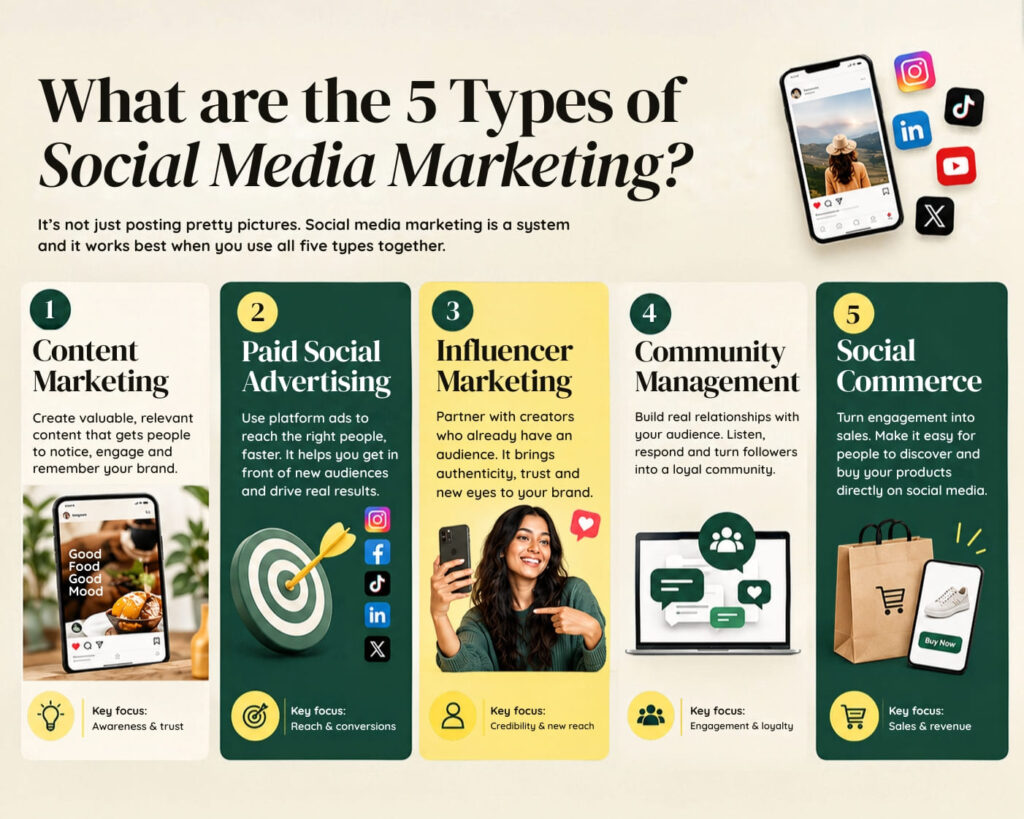
    The 5 types of social media marketing are content marketing, paid social advertising, influencer marketing, community management, and social commerce. Each one plays a different role. Some build awareness while some of them help you to drive sales. But for most brands to grow, they need to find a balanced mix of all five.

    A lot of people think social media marketing just means posting pretty pictures and hoping for likes. But that is just a very small piece of it. The brands that actually grow on social media treat it as a system and not as a hobby. And that is where you need professionals like Sorta Famous to come in and drive that balance for you.

    Each type below handles a different part of that system. Let’s break each one down properly, with real examples and how to actually start using each one.

    5 types of Social Media Marketing

    1. Content Marketing

    This is the type of marketing that most of the people will think of first as soon as they hear the word marketing. 

    Posting on Instagram, TikTok, LinkedIn, or X without paying to boost it.

    It includes photos, videos, memes, carousels, polls, whatever fits the platform and the need at hand. Herein the goal is simple, to get people to notice you and remember you before they eventually start to trust you.

    Duolingo is a great example of this. Their TikTok account barely talks about language learning. Instead, they post random skits with their owl mascot which gains them millions of views. Almost no direct selling. But everyone knows the brand now.

    Okay, I know what you’re thinking. “That’s great for a big company, what about a small business?”

    Content marketing actually works better for small businesses in some ways. You don’t need a huge budget but you need consistency and a clear idea of what your audience wants to see.

    Types of content that work well

    • Educational posts – teaching your audience something useful related to your niche
    • Behind the scenes content – showing how a product gets made or how your team works
    • Entertainment – memes, trends, humor related to your industry
    • User generated content – reposting what your customers already share about you
    • Short form video – still the strongest format across almost every platform right now

    How to actually start

    Pick one platform first. Many people/brands make mistake of trying to be everywhere at once. If your audience is mostly professionals, start with LinkedIn. If they’re younger and visual, start with Instagram or TikTok.

    Post consistently for at least 8 to 12 weeks before judging results. Growth on social media is rarely instant. 

    Most accounts that “blow up overnight” actually posted for months with small numbers before one post took off.

    2. Paid Social Advertising

    This is where you pay the platform to show your content to more people. Facebook Ads, Instagram Ads, TikTok Ads, LinkedIn Ads. You set a budget and pick your relevant audience after that the platform does the targeting.

    Why do brands use this? Because organic reach has dropped a lot over the years. Fewer people see your posts unless you pay them to (especially on Facebook and Instagram).

    Paid ads are useful for:

    • Promoting a specific product or sale
    • Retargeting people who visited your website
    • Growing followers fast
    • Testing which message converts best

    The catch is you need a clear goal before spending money because random boosted posts with no strategy usually end up wasting your budget.

    Types of paid social campaigns

    • Awareness campaigns – get your brand in front of new people, optimized for reach
    • Traffic campaigns – send people to your website or landing page
    • Conversion campaigns – optimized for actual purchases or signups, usually needs a pixel installed on your site
    • Retargeting campaigns – show ads only to people who already visited your site or engaged with your content

    A simple way to start with a small budget

    Start with $5 to $10 a day on one campaign and go on to test two or three different ad creatives against each other. Let it run for at least 3 to 5 days before making changes as your platforms need time to learn who responds best to your ad and switching things too fast ends up resetting that learning process.

    Track cost per result (not just likes and comments) as a post with 500 likes and zero sales isn’t actually performing well if your goal was sales.

    3. Influencer Marketing

    This means paying or partnering with someone who already has an audience to promote your product. Could be a huge celebrity with millions of followers or could also be a micro-influencer with 5,000 followers in a specific niche.

    Here’s something interesting. Smaller influencers often get better engagement rates than huge ones. A tech reviewer with 8,000 loyal followers might drive more real sales than a celebrity with 2 million, because their audience trusts them more.

    Influencer marketing works well for:

    • Product launches
    • Building trust in a new niche
    • Reaching an audience you can’t reach organically

    The key is picking influencers whose audience actually matches your product. 

    A fitness influencer promoting a random skincare brand rarely converts well if it feels forced.

    Different tiers of influencers

    • Nano influencers (1,000 to 10,000 followers) – highest trust, lowest cost, best for local or niche businesses
    • Micro influencers (10,000 to 100,000 followers) – still personal, decent reach, good balance of cost and results
    • Macro influencers (100,000 to 1 million followers) – wider reach, more polished content, higher cost
    • Celebrity influencers (1 million plus) – massive reach but usually low engagement rate and high cost

    How to find the right influencer

    Look past follower count. Check their comments section and not just the number of likes. 

    Real comments with actual questions or reactions matter more than a high like count with generic emoji comments which can be a sign of fake engagement.

    Ask for their engagement rate and average views if it’s not public. A creator with fewer followers but consistent views close to their follower count is usually more valuable than one with a huge follower count and low views.

    4. Community Management

    This is the type most brands ignore. Replying to comments. Answering DMs. Being present when people talk about your brand online.

    Wendy’s is famous for this on X (formerly Twitter). Their replies are witty, fast, and more importantly these days… human. People screenshot and share them which becomes free marketing on its own.

    Community management builds loyalty and moreover it also gives you direct feedback from real customers. If people keep asking the same question in your comments, that’s a sign to fix something on your website or add it to your FAQ.

    Last but not least, ignoring your comments and DMs sends a bad signal. It tells people nobody’s actually behind the account.

    What good community management actually looks like

    • Replying to comments within a few hours, not days
    • Answering DMs even when it’s a complaint, not just praise
    • Liking and responding to posts where people tag your brand
    • Joining relevant conversations in your niche, not just your own posts
    • Having an actual tone of voice instead of copy paste responses

    Why this type often gets skipped

    It’s time consuming and doesn’t show up on a graph the way follower count or ad spend does. But it’s often the reason people become repeat customers instead of one time buyers. Someone who gets a fast yet a helpful reply to a question is far more likely to trust the brand with their money.

    5. Social Commerce

    This is the newest type on this list. Selling directly through social media without sending people to a separate website.

    Instagram Shop, TikTok Shop, and Facebook Marketplace all let people buy without leaving the app. Fewer steps between seeing a product and buying it means fewer people drop off.

    Social commerce works especially well for:

    • Visual products like clothing, beauty, home decor
    • Impulse buys
    • Brands with strong short-form video content

    If your product is visual and your audience is already scrolling TikTok or Instagram, setting up a shop there removes a lot of friction from the buying process.

    Why social commerce is growing fast

    People used to see a product on social media, then open a browser, search for it, and buy it somewhere else. That’s three separate steps, and a lot of people drop off somewhere in between.

    Social commerce cuts that down to one step. See it, tap it, buy it. Platforms know this converts better, which is why they keep investing more into shop features every year.

    Getting started with social commerce

    Set up your shop catalog first, even if you’re not running ads yet. Tag products directly in your organic posts and videos. This turns every regular post into a potential sale, not just an ad.

    If you sell physical products and post video content already, this is usually the easiest type to add on top of what you’re already doing.

    How these 5 types work together

    types-of-social-media-marketing

    None of these five types work in isolation for very long and more important each of them support one another.

    Content marketing brings people in but community management keeps them engaged. Paid ads speed up growth once you know what content works but influencer marketing borrows trust from someone your audience already follows. And social commerce turns all that attention into actual sales.

    For example, a small business might post organic content for a few months and notice which posts get the most saves and shares then they put paid budget behind the best performing one. At the same time, they reply to every comment and DM which builds trust. 

    Once they have consistent content and a decent following, they add a shop feature to sell directly through their best performing posts.

    Common mistakes that brands make

    • Doing paid ads with no organic presence first. Ads work better when people can click on your profile and see real content already there.
    • Picking influencers based on follower count alone. Engagement and audience fit matter more.
    • Ignoring comments and DMs. This quietly kills trust over time.
    • Treating every platform the same way. What works on LinkedIn rarely works the same way on TikTok.
    • Giving up too early. Most accounts need consistent posting for months before results become visible.

    Tools that help with each type

    You don’t need a huge budget to manage all five types well. A few tools cover most of what you need.

    • Content marketing: Canva for graphics, CapCut for short form video editing, a simple content calendar in Notion or Google Sheets to plan posts ahead of time
    • Paid advertising: Meta Ads Manager and TikTok Ads Manager (both have built in analytics so you don’t need a separate tool when starting out)
    • Influencer marketing: platforms like Upfluence or simply searching hashtags and checking engagement manually for smaller budgets
    • Community management: most platforms have a native inbox but tools like Sprout Social or Buffer help when you’re managing comments across multiple accounts
    • Social commerce: Instagram Shop and TikTok Shop settings inside the app (no extra software needed to get started)

    Starting simple beats starting with ten different tools you never fully learn how to use.

    FAQs

    What is the most important type of social media marketing? There isn’t one type that works for everyone. Content marketing and community management are usually the best starting point since they cost the least and build the foundation for the other three.

    Do small businesses need all 5 types? No. Most small businesses start with content marketing and community management before they move into paid ads or influencer marketing once they understand their audience better.

    Which type of social media marketing gets the fastest results? Paid social advertising usually shows results the fastest since you’re paying for visibility directly. Content marketing and community management take longer but tend to build more long-term trust.