Category: Social Media Marketing

Social media marketing advice for founders and brands in India: strategy, content calendars and what works on Instagram and LinkedIn.

  • Social Media Marketing Agency in Mumbai: How to Choose One

    Social Media Marketing Agency in Mumbai: How to Choose One

    Mumbai has no shortage of social media agencies. There are solo freelancers working from home, small boutique studios, full-service marketing firms and large network agencies. They all promise growth, engagement and reach. What they actually deliver can be very different.

    This guide helps you choose a social media marketing agency in Mumbai that fits your business, your budget and your goals, without learning the hard way.

    What a Social Media Marketing Agency Does

    A good agency handles more than posting. Depending on what you need, it may cover:

    • Strategy: Deciding which platforms, topics and tone will work for your audience.
    • Content creation: Designing posts, shooting and editing videos, and writing captions.
    • Community management: Replying to comments and messages in your brand’s voice.
    • Paid campaigns: Running and optimising ads on Meta and other platforms.
    • Influencer and creator collaborations: Finding and managing the right partnerships.
    • Reporting: Showing what worked and what to do next.

    Before you start talking to agencies, decide which of these services you need. It makes comparing them much easier.

    Which Type of Agency Suits You?

    • Freelancers: Flexible and affordable, good for simple needs, but limited by one person’s time and skills.
    • Boutique agencies: Focused teams with senior attention, often a good fit for small and mid-sized businesses.
    • Full-service agencies: A wide range of services under one roof, useful when you need PR, advertising and content marketing together.
    • Large network agencies: Deep resources, usually built for large brands and larger budgets.

    There is no single best type. The right one is the agency that matches your business size, goals, budget and how closely you want to work with the people doing the job.
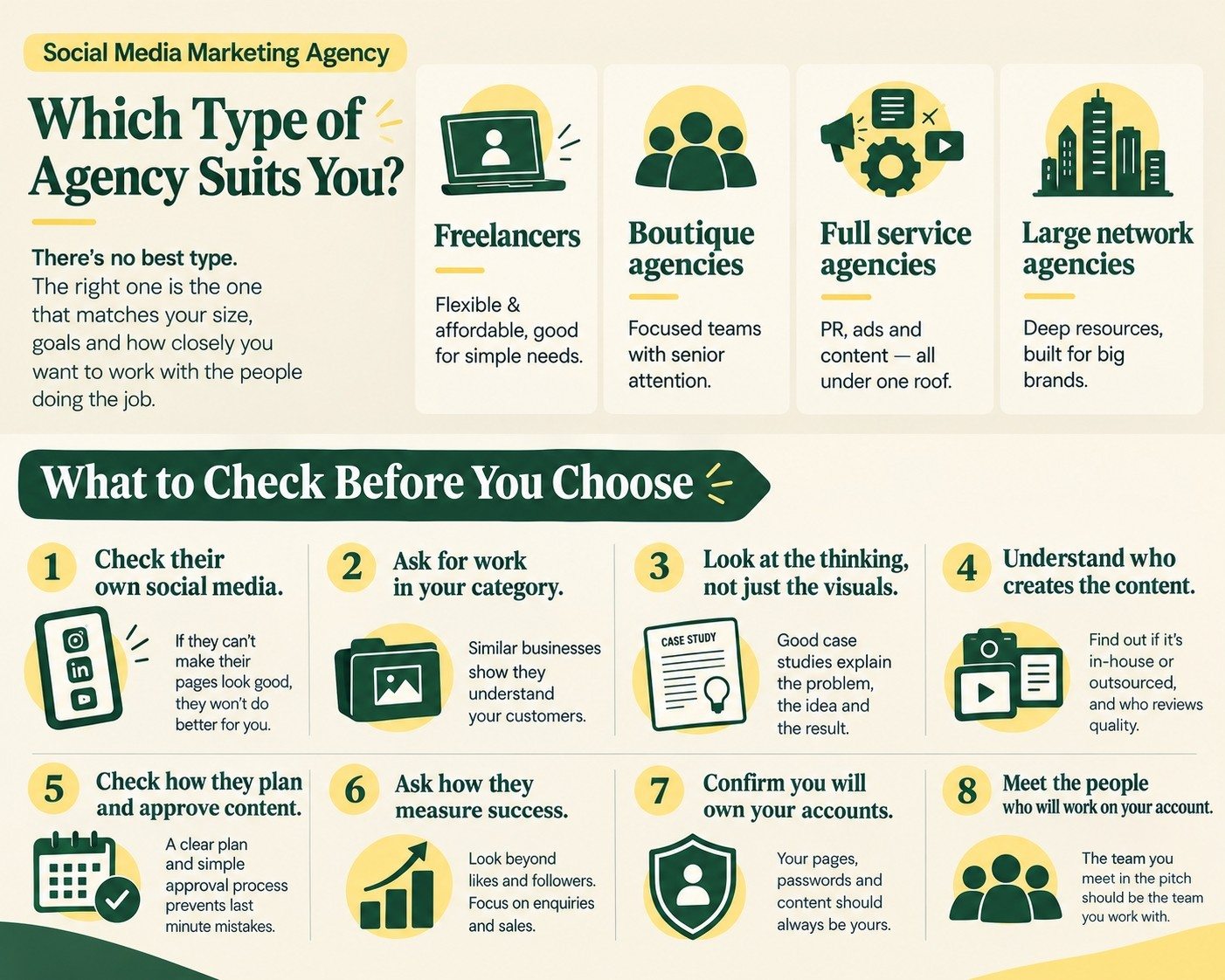
    Checklist infographic for choosing a social media marketing agency, covering strategy, portfolio, content planning, reporting, account ownership and contract terms

    What to Check Before You Choose

    1. Look at Their Own Social Media

    An agency’s own social media profiles can tell you something about its approach to content, branding and consistency. Review the quality of its posts, the tone of its communication and how it engages with its audience.

    Use this as one indicator rather than the only measure of its capabilities. Ask to see actual client work and results before making a decision.

    2. Ask for Work in Your Category

    Ask for examples of campaigns for businesses similar to yours. Relevant experience can help an agency understand your customers, competitors and industry challenges.

    Look beyond the visuals and ask what the campaign was designed to achieve.

    3. Look at the Thinking, Not Just the Visuals

    Good case studies explain the problem, the idea, the strategy and the result. Attractive posts alone do not prove that an agency can help your business grow.

    Ask how its content strategy connects to your objectives, whether that means building awareness, generating enquiries, increasing website traffic or driving sales.

    4. Understand Who Creates the Content

    Find out whether design, video production and writing are handled by the agency’s own team or outsourced. Ask who reviews the work, manages revisions and ensures quality.

    You should know who is responsible for your content and who to contact when you need changes.

    5. Check How They Plan and Approve Content

    A clear monthly content plan and a simple approval process help prevent last-minute mistakes. Ask when you will receive the content calendar, how approvals work and how many revisions are included.

    Make sure the process is practical for your team and that deadlines and responsibilities are clearly defined.

    6. Ask How They Measure Success

    Good agencies track business signals such as enquiries and sales, not only likes and followers. Depending on your goals, useful metrics may include:

    • Reach and brand awareness.
    • Engagement and audience quality.
    • Website traffic and enquiries.
    • Qualified leads and conversions.
    • Sales and advertising performance, where applicable.

    Ask how often the agency shares reports and how it uses performance data to improve future campaigns. If paid campaigns are important to your business, explore performance marketing services that focus on measurable outcomes.

    7. Confirm You Will Own Your Accounts

    Your business should retain ownership and appropriate administrator access to its social media pages, advertising accounts, analytics and content assets.

    Make sure access permissions are set up securely and that your agreement explains what happens to accounts, files and campaign data if the contract ends.

    8. Meet the People Who Will Work on Your Account

    The team presenting the pitch should be the team you work with. Ask to meet the people responsible for strategy, content creation and day-to-day account management.

    Direct communication with the right people can make collaboration easier and help prevent misunderstandings.

    Red Flags to Watch Out For

    • Promising a specific number of followers: Genuine growth cannot be guaranteed, and fake followers can harm your brand’s credibility.
    • No clear strategy: If the plan is just a posting schedule, you are buying content production rather than a complete marketing approach.
    • No access to your analytics: You should be able to access your accounts and review your own performance data.
    • Long lock-ins with no way out: Understand the cancellation terms before signing. A good agency earns its renewals by delivering value.
    • Copying what other brands do: Your content should be built around your own business, customers and positioning.

    Questions to Ask in Your First Meeting

    Before hiring a social media marketing agency in Mumbai, ask these questions:

    • What would you do differently for our business compared with other brands?
    • Who will run our account day to day?
    • How many revisions and approvals are part of the process?
    • How will you report results, and how often?
    • What do you need from us each month?
    • What happens if we want to stop working together?

    The answers will help you understand how the agency works, what it expects from your team and whether its process fits your business.

    How Long Before You See Results?

    Social media usually takes a few months to show clear results, although the timeline depends on your industry, audience, budget and objectives.

    Early signs of progress may include better-quality enquiries, more replies, steadier engagement and increased interest in your business. Paid campaigns may generate initial data sooner, but consistent optimisation is still important.

    Be cautious of anyone promising overnight growth or guaranteed business results. Focus on measurable progress and whether your social media activity is contributing to your wider business goals.

    How Sorta Famous Helps

    Sorta Famous is a PR and marketing agency based in Andheri, Mumbai. Social media marketing is one of the services we offer, alongside public relations (PR), brand management, personal branding and performance marketing.

    This integrated approach helps your social media presence work together with your press coverage, brand identity and reputation.

    Every engagement starts with an in-depth audit of your current presence and what you want to achieve. From there, the strategy is shaped around your business and its objectives.

    Support can be project-based, with no long-term retainer, and you work directly with the strategists handling your account.

    If you are comparing agencies and want a straightforward conversation about what you need, get in touch with Sorta Famous to enquire about a free 30-minute consultation.

    Frequently Asked Questions

    What does a social media marketing agency do?

    It plans and manages your social media presence. This can include strategy, content creation, community management, paid advertising, creator partnerships and performance reporting.

    How do I choose a social media agency in Mumbai?

    Look at its own social media profiles, ask for relevant work, understand who creates your content, check how results are reported and confirm that you will retain ownership of your accounts.

    Should I hire a freelancer or an agency?

    A freelancer can work well for simple requirements and smaller budgets. An agency may suit you better when you need strategy, a team of specialists and several marketing services working together.

    Do social media agencies guarantee followers?

    Be cautious of agencies that guarantee specific follower counts. Followers can be purchased, but they do not necessarily bring customers and can hurt your credibility. Focus on genuine engagement, relevant audiences and business results.

    How long should I commit to an agency?

    Start with a clear scope of work and review results regularly. Understand the cancellation terms before signing, and be careful about long lock-ins before you have evaluated the agency’s work.

    Who owns my social media accounts?

    You should. Retain ownership and administrator access to your accounts, and make sure your contract clearly explains ownership of accounts, content and campaign data.
  • Social Media Marketing in Andheri: A Local Business Guide

    Social Media Marketing in Andheri: A Local Business Guide

    Andheri is one of the busiest parts of Mumbai, and also one of the most competitive for local businesses. Within a few minutes’ walk of almost any shop, cafe, salon, gym or clinic, there are three more offering something similar. When customers choose, they rarely walk around comparing. They open their phone, search, scroll and decide.

    That is why social media matters so much for Andheri businesses. This guide covers how to use it to reach people who live, work and travel in your area.

    Why Local Social Media Works in Andheri

    Andheri is not one audience. Andheri West has residential neighbourhoods, busy markets and many people from the film, television and music industries who live and work in the area. Andheri East has business parks, offices and industrial and commercial areas, along with its own residential pockets. A cafe near an office cluster serves a very different crowd from a salon in a residential lane.

    Social media lets you speak to the exact people near you, at the times they are deciding where to go, eat, shop or book.

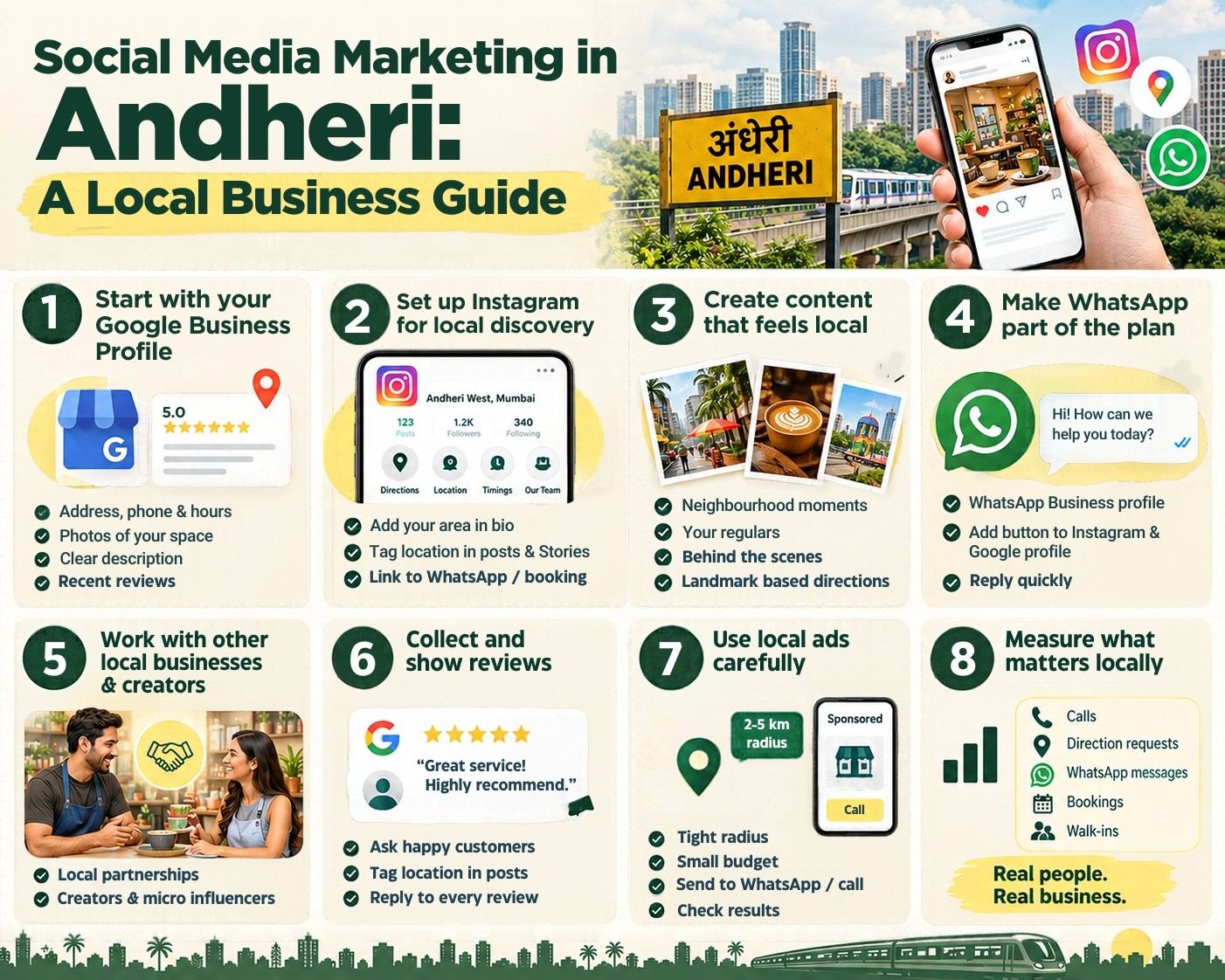
    Infographic showing eight social media marketing steps for local businesses in Andheri, including Google Business Profile, Instagram, local content, WhatsApp, collaborations, reviews, local ads and performance tracking

    Step 1: Start with Your Google Business Profile

    For local businesses, this comes before any social media post. When someone searches “near me” or looks for a service in Andheri, your Google Business Profile is often one of the first things they see.

    Make sure it includes:

    • Your correct address, phone number and opening hours.
    • Good photos of your space, products or team.
    • A clear description mentioning your area and services.
    • Recent customer reviews, along with thoughtful replies.

    Then make sure your social media profiles display the same business details. Consistency helps customers find and contact you without confusion.

    Step 2: Set Up Instagram for Local Discovery

    Instagram works well for local businesses when it is set up properly. Make it easy for people in Andheri to discover your business and take the next step.

    • Mention your area in your bio, for example, “Andheri West, Mumbai”.
    • Add your location to posts and Stories so people can understand where you operate.
    • Create a Highlight with directions, nearby landmarks and business timings.
    • Link to WhatsApp or a booking page so interested customers can contact you quickly.

    For more consistent branding, explore our social media and marketing services at Sorta Famous.

    Step 3: Create Content That Feels Local

    Generic content gets scrolled past. Content that shows you belong to the neighbourhood gets noticed. Give people a reason to recognise your business as part of their everyday lives.

    • Neighbourhood moments: Share monsoon days, festival decorations and local events as seen from your shop, cafe or studio.
    • Your regular customers: Share customer stories and thank-you posts, with their permission.
    • Behind the scenes: Show how you prepare, make or deliver what you sell.
    • Landmark-based directions: Use phrases such as “two minutes from [landmark]” to help people picture the route.
    • Local tips: Create short guides about things your customers care about in the area.

    Use Marathi, Hindi or English in your captions to match the way your customers speak. Authentic, locally relevant content can make your business feel more approachable.

    Step 4: Make WhatsApp Part of the Plan

    Many customers prefer to message a business before visiting or making a purchase. Set up a WhatsApp Business profile with your catalogue, opening hours and quick replies.

    • Add a WhatsApp contact link to your Instagram bio.
    • Make it easy for customers to ask questions, enquire about prices or book appointments.
    • Prepare quick replies for common questions about services, availability and timings.
    • Respond promptly and professionally to genuine enquiries.

    A fast, helpful response can make the difference between a potential customer choosing your business or moving on to another option.

    Step 5: Work with Other Local Businesses and Creators

    Neighbouring businesses that serve the same customers without competing directly with you can be valuable partners. A gym and a healthy cafe, or a salon and a boutique, can collaborate on offers and cross-promote each other’s services.

    Local creators and micro-influencers who live or work in Andheri can also introduce your business to an audience that already trusts their recommendations.

    Choose collaborators whose audience matches your target customers. Focus on genuine engagement and local relevance rather than follower counts alone.

    Step 6: Collect and Showcase Customer Reviews

    In a crowded area, customer reviews can influence the final decision. Ask satisfied customers to leave a Google review and share selected testimonials on your social media pages, with permission where appropriate.

    • Make it easy to leave a review by sharing your review link.
    • Thank customers for positive feedback.
    • Respond to negative reviews calmly and professionally.
    • Use recurring feedback to improve your service.

    Never buy fake reviews or offer incentives in exchange for positive reviews. Genuine feedback builds more lasting trust.

    Step 7: Use Local Ads Carefully

    If you run paid social media campaigns, target people within a relevant radius of your business instead of automatically targeting all of Mumbai.

    Start with a small budget, test one clear offer and direct people to WhatsApp, a call button or a booking page. Check the results after a few days before increasing your spending.

    Track which campaigns generate meaningful enquiries and visits rather than focusing only on impressions or likes.

    Step 8: Measure What Matters Locally

    Followers are not the main goal. Track the signals that connect social media activity to real business results.

    • Calls from potential customers.
    • Requests for directions.
    • WhatsApp messages and genuine enquiries.
    • Bookings and appointments.
    • Walk-ins and completed sales.

    Ask new customers how they found you and record their answers. Over time, this will help you identify which channels and campaigns bring in the most relevant customers.

    Common Social Media Mistakes Local Businesses Make

    • Ignoring Google while focusing only on Instagram: Local discovery often begins with a search, so keep your Google Business Profile updated.
    • Posting only offers: People are more likely to engage with businesses that share useful, interesting and locally relevant content.
    • Using inconsistent business details: Different phone numbers, addresses or opening hours across platforms can confuse customers.
    • Replying too slowly: Delayed responses can cause potential customers to choose a competitor.
    • Targeting too wide an audience: Spending money to reach all of Mumbai may be inefficient when most of your customers live or work nearby.

    How Sorta Famous Helps Andheri Businesses

    Sorta Famous is a PR and marketing agency based in Andheri, Mumbai. We help local businesses, founders and public figures build a social media presence with a clear strategy behind it.

    We start by auditing your existing online presence and understanding your goals. From there, we plan content, advertising and visibility strategies around your business and your customers.

    Our support can be project-based, without a long-term retainer, and you work directly with the strategists handling your account rather than through layers of account management.

    If you run a business in Andheri and want to improve your online visibility, get in touch with Sorta Famous to enquire about a free 30-minute consultation.

    Frequently Asked Questions

    Why is social media important for businesses in Andheri?

    Customers often search and compare businesses on their phones before visiting. A strong social media presence, supported by a complete Google Business Profile, helps your business become easier to discover and gives potential customers reasons to trust you.

    Which social media platform is best for local businesses in Andheri?

    Instagram and WhatsApp work well for many consumer-facing businesses. LinkedIn can be useful for businesses serving offices and professionals. Google Business Profile should also be a priority for businesses that depend on local discovery.

    How often should a local business post on social media?

    Three to four posts a week, supported by regular Stories, can be a reasonable starting point. Choose a schedule you can maintain consistently while keeping your content useful and relevant.

    Should I run paid ads for my local business?

    Once your profiles and Google Business Profile are in good shape, small local campaigns can help attract potential customers. Start with a relevant audience, test one offer and measure calls, enquiries and bookings before increasing your budget.

    How do I get more Google reviews?

    Ask satisfied customers directly after a positive experience. Make the process easy by sharing your Google review link through WhatsApp or another appropriate channel. Always seek honest feedback rather than asking customers specifically for positive reviews.

    Can a marketing agency help a small local business?

    Yes. A marketing agency can help plan content, improve your online profiles and manage campaigns while you focus on serving customers. Look for a team that understands your local market and offers a scope of work suited to your budget and needs.

  • Instagram content calendar for small businesses

    Instagram content calendar for small businesses

    Most small businesses don’t struggle with Instagram because they have nothing to say. They struggle because every morning starts with the same question: what do we post today? Some days the answer is a rushed festival greeting. Some days it is nothing at all. After a few weeks, the page goes quiet.

    An Instagram content calendar fixes this. It is a simple plan that shows what you will post, when and why. This guide shows you how to build one for a small business in India, with a template you can copy.

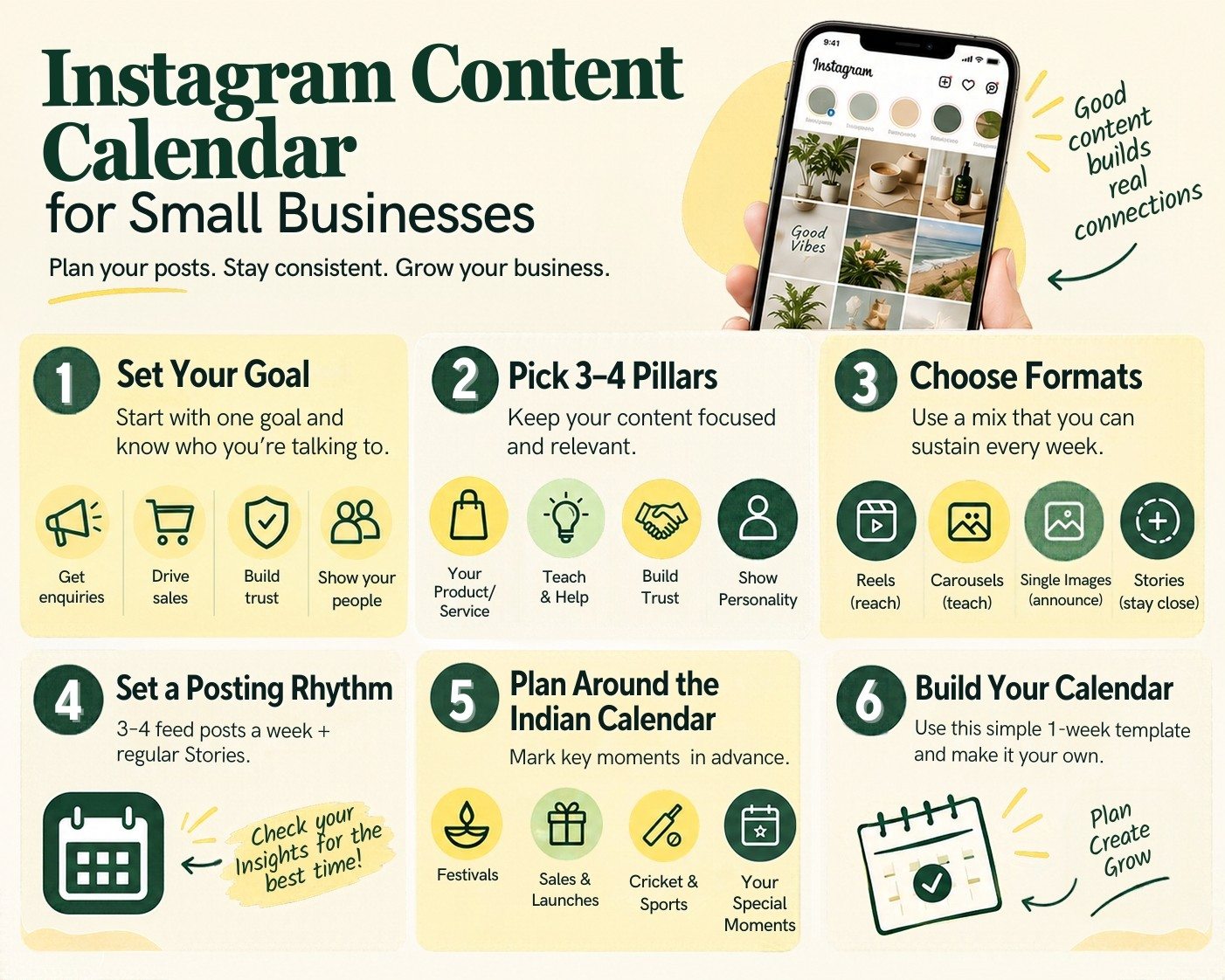
    Infographic showing the 8 steps to build an Instagram content calendar for a small business in India, from setting a goal to a monthly review

    Why a content calendar works

    A content calendar does three things for a small business:

    • It keeps you consistent. Regular posting matters more than occasional bursts of effort.
    • It removes daily stress. You decide once, instead of every morning.
    • It connects your posts to your goals. Every post has a purpose, so your page doesn’t turn into a random mix of images.

    Step 1: Decide what Instagram is for

    Start with one goal. It could be getting enquiries, selling a product, building trust, or showing the people behind the business. Also decide who you are talking to. A calendar built for young shoppers will look different from one built for business owners.

    Step 2: Choose 3 to 4 content pillars

    Content pillars are the main topics you post about again and again. For a small business, a simple mix works well:

    • Show your product or service: what you offer and how it works
    • Teach something useful: tips, how tos and answers to common questions
    • Build trust: customer stories, reviews and behind the scenes moments
    • Show personality: your team, your story and your values

    Every post should fit into one of these pillars. If it doesn’t, ask whether it needs to be posted at all.

    Step 3: Pick the formats you can sustain

    Instagram offers several formats, and each does a different job:

    • Reels: short videos that can reach people who don’t follow you yet
    • Carousels: swipeable posts that work well for tips, steps and comparisons
    • Single images: good for announcements, offers and product highlights
    • Stories: daily, casual updates that keep followers close

    Choose the mix you can actually produce every week. Two good Reels a week are better than five rushed ones you stop making.

    Step 4: Set a posting rhythm

    For most small businesses, three to four feed posts a week plus regular Stories is a realistic starting point. Check your Instagram Insights to see when your followers are most active, and schedule your posts around those times.

    Step 5: Plan around the Indian calendar

    Indian businesses have a calendar of moments that customers care about. Mark these in advance so you are not scrambling at the last minute:

    • Major festivals such as Diwali, Navratri, Ganesh Chaturthi, Holi, Raksha Bandhan, Eid and Christmas
    • Wedding and gifting seasons
    • Cricket seasons and big sporting events
    • Your own moments, such as sales, launches and anniversaries

    Plan these posts a few weeks ahead, and keep the rest of the calendar flexible.

    Step 6: Build your calendar

    Here is a simple one week template. Copy it, and swap the ideas for your own business.

    Day Format Pillar Example idea
    Monday Carousel Teach something useful 5 tips related to your product or service
    Tuesday Stories Build trust Behind the scenes of today’s work
    Wednesday Reel Show your product or service A 30 second demo of how it works
    Thursday Stories Teach something useful Question box or poll on a common customer doubt
    Friday Single image Build trust A customer review or testimonial
    Saturday Reel Show personality Meet the team or the story behind the business
    Sunday Rest and plan None Reply to comments and DMs, and plan next week

    Copy the same layout into a spreadsheet or a planner, and extend it to four weeks.

    Step 7: Batch your work and schedule it

    Set aside one block each week, or each month, to shoot photos and videos, write captions and schedule posts. Batching saves time and keeps the quality steady. Keep a running note of ideas from customer questions and daily work so you never start from a blank page.

    Step 8: Review every month

    At the end of each month, look at which posts brought the most saves, shares, DMs and enquiries. Do more of what worked and drop what didn’t. A calendar is not fixed. It improves each month.

    Common mistakes with Instagram calendars

    • Planning too much. A calendar you can’t keep is worse than a simple one you can.
    • Only posting offers. People get bored of constant selling.
    • Ignoring comments and DMs. Posting is half the work. Replies build relationships.
    • Copying trends that don’t fit. Not every trending sound or format suits your brand.
    • Never reviewing results. Without a monthly check, you repeat the same mistakes.

    How Sorta Famous helps

    Sorta Famous is a PR and marketing agency based in Andheri, Mumbai, that helps small businesses and brands build social media presence with a clear strategy behind it. We start with an audit of what you already have and what you want to achieve, then plan content that fits your brand and your calendar, not a generic template. Support can be project-based, with no long-term retainer, and you work directly with the strategists on your account.

    If you want a content plan built for your business, get in touch with Sorta Famous for a free 30-minute consult.

    Frequently asked questions

    How many times a week should a small business post on Instagram?

    Three to four feed posts a week plus regular Stories is a good starting point. Choose a pace you can keep for months.

    How far ahead should I plan my content calendar?

    Plan the next month in detail, and mark major festivals and sales a few months ahead.

    What should I post on Instagram for my small business?

    A mix of your products, useful tips, customer proof and glimpses of your team. Use the content pillars in this guide to keep the mix balanced.

    Should I use Reels or regular posts?

    Both. Reels help new people find you, while carousels and images help existing followers understand and trust you.

    What is the best time to post on Instagram in India?

    It depends on your audience. Check your Instagram Insights to see when your followers are most active, then post around those times.

    Do I need a tool to schedule my posts?

    Not necessarily. You can schedule posts within Instagram, or use a free planner or spreadsheet to track your calendar.

  • Social media strategy for founders in India

    Social media strategy for founders in India

    Most founders fall into one of two traps on social media. Either they post nothing because there is no time, or they post everything with no direction and wonder why nothing comes back. Neither is a strategy. A strategy is simply a set of clear choices: where you show up, what you say, how often, and what you want out of it.

    This guide breaks down a social media strategy for founders in India that you can actually follow while running a business.

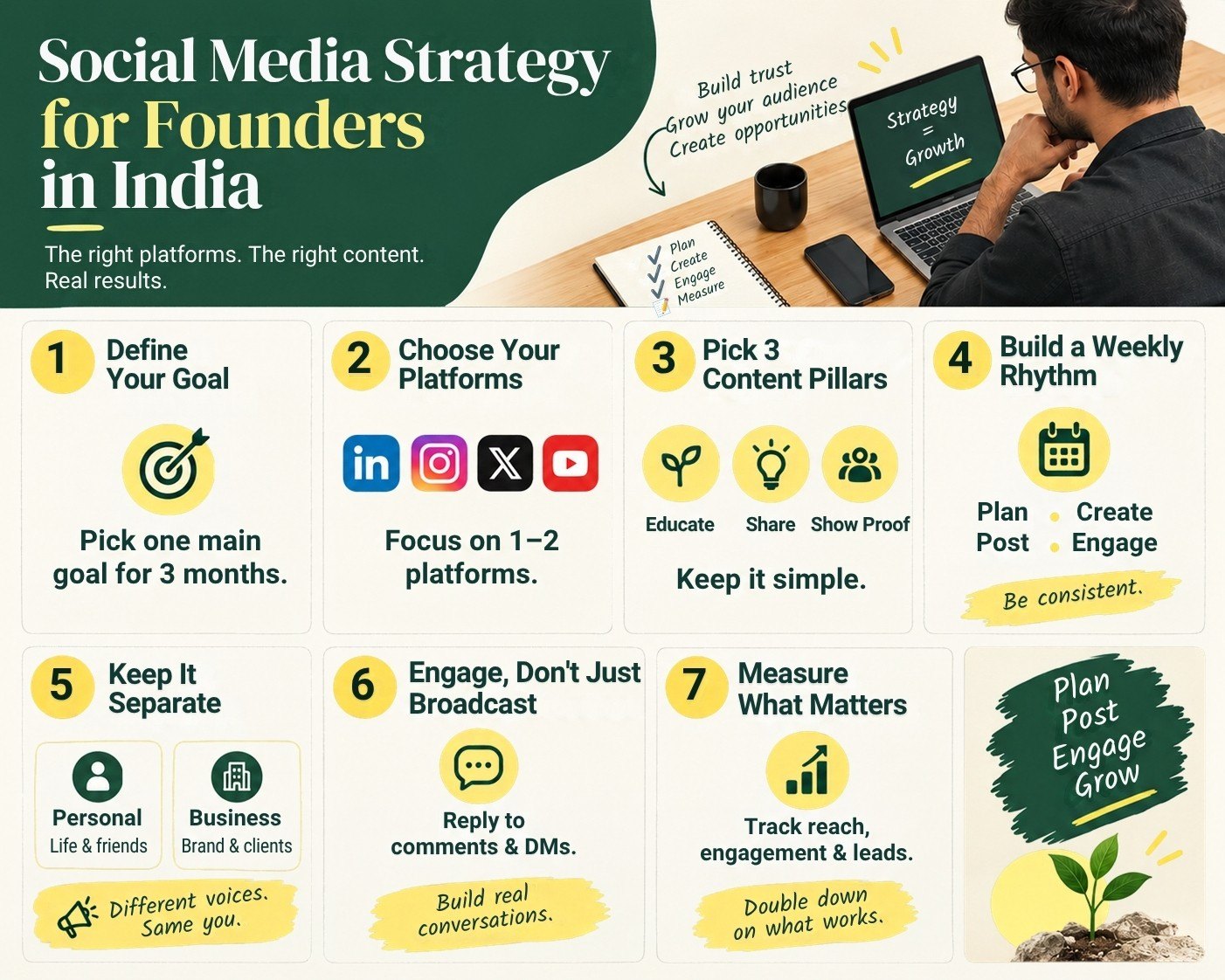
    Infographic showing the 7 steps of a social media strategy for founders in India, from setting a goal to measuring results

    Why founders need a social media strategy of their own

    People connect with people far more easily than they connect with logos. A founder who shares how they think, what they are building and what they have learned gives customers, investors and future hires a reason to trust the brand before they ever speak to anyone.

    That trust has real uses. It brings in enquiries, makes hiring easier, opens doors to journalists and helps investors feel they already know you. But it only works when it is planned. Random posting, however well meant, rarely builds anything.

    Step 1: Decide what you want social media to do for you

    Pick one main goal for the next three months. It could be:

    • Getting more customers or enquiries
    • Attracting good people to work with you
    • Building credibility with investors or partners
    • Getting noticed by journalists and industry events

    You can benefit from all of these over time, but your first goal decides what you post and where. A founder who wants B2B leads posts very differently from one who wants to sell a consumer product.

    Step 2: Choose one or two platforms, not five

    Trying to be everywhere is the fastest way to burn out. Match the platform to your goal and your audience:

    • LinkedIn: best for B2B, hiring, investors and professional credibility
    • Instagram: best for consumer brands, visual products and behind-the-scenes stories
    • X: useful for startup, tech and media communities that talk in real time
    • YouTube: strong for long-form explanations and building depth over time

    Start with one platform and do it well for at least three months before adding another.

    Step 3: Pick three content pillars

    Content pillars are the three topics you come back to again and again. They remove the daily “what do I post” problem. A simple set for founders:

    • The building story: decisions, mistakes, milestones and what you are learning
    • Your expertise: practical lessons from your industry that help your audience
    • Proof: customer stories, results and real moments from the business

    Mix these through the week so your profile feels useful and human, not only promotional.

    Step 4: Build a weekly rhythm you can keep

    Consistency beats intensity. Three good posts a week that you can sustain are better than a daily burst that stops after a month. A simple routine:

    • Set aside one block each week to plan and write the week’s posts
    • Keep a running note of ideas from meetings, customer calls and conversations
    • Batch your writing so posting never depends on your mood that day

    Step 5: Run your personal profile and company page differently

    Your personal profile and your company page do different jobs. The personal profile is where trust and conversation happen. The company page is the official home for announcements, hiring and proof. Make sure both tell the same story, but let the founder profile carry the voice.

    Step 6: Engage, don’t just broadcast

    Posting is half the work. Reply to every comment in the first few hours. Comment thoughtfully on posts by people in your industry. Reply to DMs even if the answer is short. Most of the opportunities that come from social media start in the comments and inbox, not in the post itself.

    Step 7: Measure what matters

    Likes feel good but they rarely pay the bills. Track the signals that connect to your goal: enquiries, DMs from the right people, profile visits, mentions from journalists, and applications for open roles. Review them once a month and double down on the content that brings them.

    Common mistakes founders make on social media

    • Being on every platform at once. Spread thin, nothing gets the attention it needs.
    • Only posting when there is good news. An audience that only hears announcements stops listening.
    • Sounding like a press release. People follow founders for their point of view, not for corporate language.
    • Ignoring comments and messages. It quietly tells people no one is really there.
    • Quitting too early. Most profiles need months of steady posting before results show up.
    • Copying someone else’s voice. What works for another founder rarely works unchanged for you.

    Infographic showing the 7 steps of a social media strategy for founders in India, from setting a goal to measuring results

    How Sorta Famous helps founders with social media

    Sorta Famous is a Mumbai-based PR and marketing agency that helps founders and brands build visibility that lasts. All of our engagements start with an in-depth audit of your current presence and goals, followed by a content and media strategy built around your calendar and not a generic content plan. We also give project-based support without a long-term retainer, for founders who need a focused push around a launch or milestone. And there are no account managers in between. You work directly with the strategists running your campaign.

    To start building a social media presence with a strategy behind it, get in touch with Sorta Famous for a free 30-minute consult.

    Frequently asked questions

    Which social media platform is best for founders in India?

    It depends on your goal. LinkedIn works best for B2B, hiring and investor credibility, while Instagram suits consumer brands and visual products. Start with one and add more only when the first one is running smoothly.

    How often should a founder post on social media?

    Three times a week is a realistic starting point for most founders. It is better to post at a pace you can keep for months than to go daily and stop.

    Should a founder post as themselves or as the company?

    Both, with different roles. The personal profile carries the voice and builds trust, while the company page handles official updates, hiring and proof.

    How long does it take for founder social media to show results?

    Usually a few months of steady posting. Early results often show up as better conversations and DMs before they show up as numbers.

    Do I need to show my face and share personal stories?

    Not necessarily. You can lead with your expertise and the story of the business. Share only what you are comfortable with, as long as the voice feels real.

    Can I hand over my social media to someone else?

    Yes, in part. A team can plan, draft and schedule content, but the ideas and opinions should come from you. The strongest founder profiles are built on the founder’s real point of view.

  • What are the 5 types of Social Media Marketing?

    What are the 5 types of Social Media Marketing?

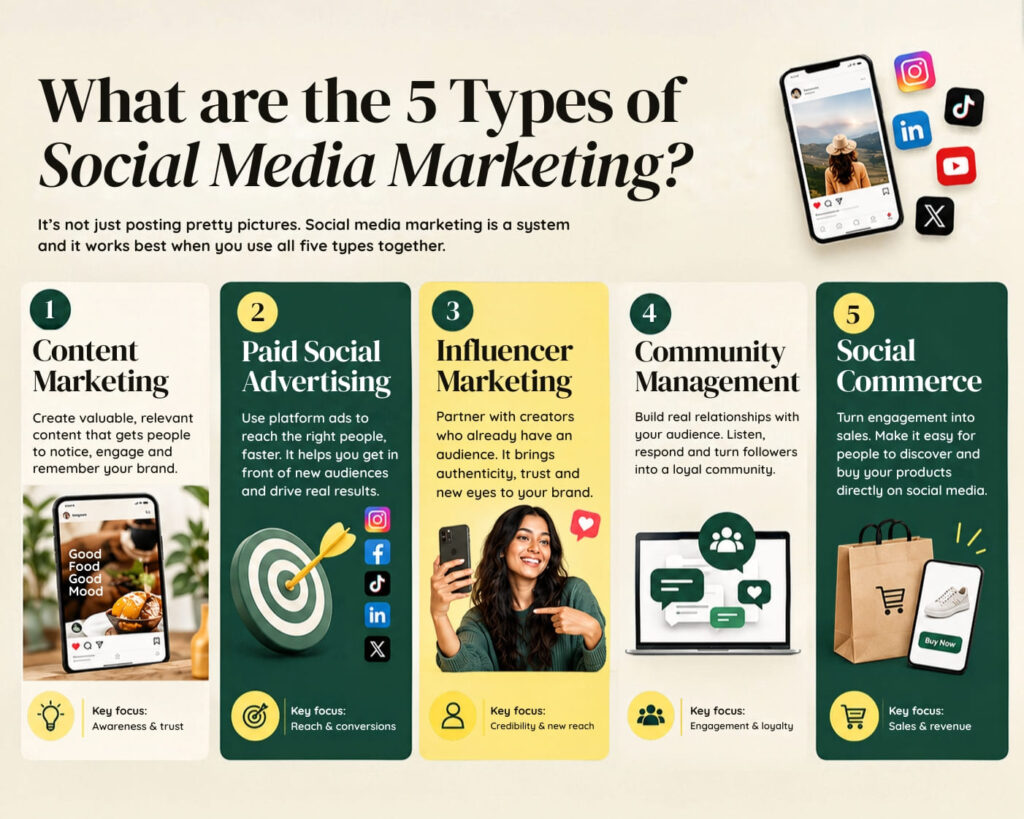
    The 5 types of social media marketing are content marketing, paid social advertising, influencer marketing, community management, and social commerce. Each one plays a different role. Some build awareness while some of them help you to drive sales. But for most brands to grow, they need to find a balanced mix of all five.

    A lot of people think social media marketing just means posting pretty pictures and hoping for likes. But that is just a very small piece of it. The brands that actually grow on social media treat it as a system and not as a hobby. And that is where you need professionals like Sorta Famous to come in and drive that balance for you.

    Each type below handles a different part of that system. Let’s break each one down properly, with real examples and how to actually start using each one.

    5 types of Social Media Marketing

    1. Content Marketing

    This is the type of marketing that most of the people will think of first as soon as they hear the word marketing. 

    Posting on Instagram, TikTok, LinkedIn, or X without paying to boost it.

    It includes photos, videos, memes, carousels, polls, whatever fits the platform and the need at hand. Herein the goal is simple, to get people to notice you and remember you before they eventually start to trust you.

    Duolingo is a great example of this. Their TikTok account barely talks about language learning. Instead, they post random skits with their owl mascot which gains them millions of views. Almost no direct selling. But everyone knows the brand now.

    Okay, I know what you’re thinking. “That’s great for a big company, what about a small business?”

    Content marketing actually works better for small businesses in some ways. You don’t need a huge budget but you need consistency and a clear idea of what your audience wants to see.

    Types of content that work well

    • Educational posts – teaching your audience something useful related to your niche
    • Behind the scenes content – showing how a product gets made or how your team works
    • Entertainment – memes, trends, humor related to your industry
    • User generated content – reposting what your customers already share about you
    • Short form video – still the strongest format across almost every platform right now

    How to actually start

    Pick one platform first. Many people/brands make mistake of trying to be everywhere at once. If your audience is mostly professionals, start with LinkedIn. If they’re younger and visual, start with Instagram or TikTok.

    Post consistently for at least 8 to 12 weeks before judging results. Growth on social media is rarely instant. 

    Most accounts that “blow up overnight” actually posted for months with small numbers before one post took off.

    2. Paid Social Advertising

    This is where you pay the platform to show your content to more people. Facebook Ads, Instagram Ads, TikTok Ads, LinkedIn Ads. You set a budget and pick your relevant audience after that the platform does the targeting.

    Why do brands use this? Because organic reach has dropped a lot over the years. Fewer people see your posts unless you pay them to (especially on Facebook and Instagram).

    Paid ads are useful for:

    • Promoting a specific product or sale
    • Retargeting people who visited your website
    • Growing followers fast
    • Testing which message converts best

    The catch is you need a clear goal before spending money because random boosted posts with no strategy usually end up wasting your budget.

    Types of paid social campaigns

    • Awareness campaigns – get your brand in front of new people, optimized for reach
    • Traffic campaigns – send people to your website or landing page
    • Conversion campaigns – optimized for actual purchases or signups, usually needs a pixel installed on your site
    • Retargeting campaigns – show ads only to people who already visited your site or engaged with your content

    A simple way to start with a small budget

    Start with $5 to $10 a day on one campaign and go on to test two or three different ad creatives against each other. Let it run for at least 3 to 5 days before making changes as your platforms need time to learn who responds best to your ad and switching things too fast ends up resetting that learning process.

    Track cost per result (not just likes and comments) as a post with 500 likes and zero sales isn’t actually performing well if your goal was sales.

    3. Influencer Marketing

    This means paying or partnering with someone who already has an audience to promote your product. Could be a huge celebrity with millions of followers or could also be a micro-influencer with 5,000 followers in a specific niche.

    Here’s something interesting. Smaller influencers often get better engagement rates than huge ones. A tech reviewer with 8,000 loyal followers might drive more real sales than a celebrity with 2 million, because their audience trusts them more.

    Influencer marketing works well for:

    • Product launches
    • Building trust in a new niche
    • Reaching an audience you can’t reach organically

    The key is picking influencers whose audience actually matches your product. 

    A fitness influencer promoting a random skincare brand rarely converts well if it feels forced.

    Different tiers of influencers

    • Nano influencers (1,000 to 10,000 followers) – highest trust, lowest cost, best for local or niche businesses
    • Micro influencers (10,000 to 100,000 followers) – still personal, decent reach, good balance of cost and results
    • Macro influencers (100,000 to 1 million followers) – wider reach, more polished content, higher cost
    • Celebrity influencers (1 million plus) – massive reach but usually low engagement rate and high cost

    How to find the right influencer

    Look past follower count. Check their comments section and not just the number of likes. 

    Real comments with actual questions or reactions matter more than a high like count with generic emoji comments which can be a sign of fake engagement.

    Ask for their engagement rate and average views if it’s not public. A creator with fewer followers but consistent views close to their follower count is usually more valuable than one with a huge follower count and low views.

    4. Community Management

    This is the type most brands ignore. Replying to comments. Answering DMs. Being present when people talk about your brand online.

    Wendy’s is famous for this on X (formerly Twitter). Their replies are witty, fast, and more importantly these days… human. People screenshot and share them which becomes free marketing on its own.

    Community management builds loyalty and moreover it also gives you direct feedback from real customers. If people keep asking the same question in your comments, that’s a sign to fix something on your website or add it to your FAQ.

    Last but not least, ignoring your comments and DMs sends a bad signal. It tells people nobody’s actually behind the account.

    What good community management actually looks like

    • Replying to comments within a few hours, not days
    • Answering DMs even when it’s a complaint, not just praise
    • Liking and responding to posts where people tag your brand
    • Joining relevant conversations in your niche, not just your own posts
    • Having an actual tone of voice instead of copy paste responses

    Why this type often gets skipped

    It’s time consuming and doesn’t show up on a graph the way follower count or ad spend does. But it’s often the reason people become repeat customers instead of one time buyers. Someone who gets a fast yet a helpful reply to a question is far more likely to trust the brand with their money.

    5. Social Commerce

    This is the newest type on this list. Selling directly through social media without sending people to a separate website.

    Instagram Shop, TikTok Shop, and Facebook Marketplace all let people buy without leaving the app. Fewer steps between seeing a product and buying it means fewer people drop off.

    Social commerce works especially well for:

    • Visual products like clothing, beauty, home decor
    • Impulse buys
    • Brands with strong short-form video content

    If your product is visual and your audience is already scrolling TikTok or Instagram, setting up a shop there removes a lot of friction from the buying process.

    Why social commerce is growing fast

    People used to see a product on social media, then open a browser, search for it, and buy it somewhere else. That’s three separate steps, and a lot of people drop off somewhere in between.

    Social commerce cuts that down to one step. See it, tap it, buy it. Platforms know this converts better, which is why they keep investing more into shop features every year.

    Getting started with social commerce

    Set up your shop catalog first, even if you’re not running ads yet. Tag products directly in your organic posts and videos. This turns every regular post into a potential sale, not just an ad.

    If you sell physical products and post video content already, this is usually the easiest type to add on top of what you’re already doing.

    How these 5 types work together

    types-of-social-media-marketing

    None of these five types work in isolation for very long and more important each of them support one another.

    Content marketing brings people in but community management keeps them engaged. Paid ads speed up growth once you know what content works but influencer marketing borrows trust from someone your audience already follows. And social commerce turns all that attention into actual sales.

    For example, a small business might post organic content for a few months and notice which posts get the most saves and shares then they put paid budget behind the best performing one. At the same time, they reply to every comment and DM which builds trust. 

    Once they have consistent content and a decent following, they add a shop feature to sell directly through their best performing posts.

    Common mistakes that brands make

    • Doing paid ads with no organic presence first. Ads work better when people can click on your profile and see real content already there.
    • Picking influencers based on follower count alone. Engagement and audience fit matter more.
    • Ignoring comments and DMs. This quietly kills trust over time.
    • Treating every platform the same way. What works on LinkedIn rarely works the same way on TikTok.
    • Giving up too early. Most accounts need consistent posting for months before results become visible.

    Tools that help with each type

    You don’t need a huge budget to manage all five types well. A few tools cover most of what you need.

    • Content marketing: Canva for graphics, CapCut for short form video editing, a simple content calendar in Notion or Google Sheets to plan posts ahead of time
    • Paid advertising: Meta Ads Manager and TikTok Ads Manager (both have built in analytics so you don’t need a separate tool when starting out)
    • Influencer marketing: platforms like Upfluence or simply searching hashtags and checking engagement manually for smaller budgets
    • Community management: most platforms have a native inbox but tools like Sprout Social or Buffer help when you’re managing comments across multiple accounts
    • Social commerce: Instagram Shop and TikTok Shop settings inside the app (no extra software needed to get started)

    Starting simple beats starting with ten different tools you never fully learn how to use.

    FAQs

    What is the most important type of social media marketing? There isn’t one type that works for everyone. Content marketing and community management are usually the best starting point since they cost the least and build the foundation for the other three.

    Do small businesses need all 5 types? No. Most small businesses start with content marketing and community management before they move into paid ads or influencer marketing once they understand their audience better.

    Which type of social media marketing gets the fastest results? Paid social advertising usually shows results the fastest since you’re paying for visibility directly. Content marketing and community management take longer but tend to build more long-term trust.