Author: Nandini Mahant

  • Social media strategy for founders in India

    Social media strategy for founders in India

    Most founders fall into one of two traps on social media. Either they post nothing because there is no time, or they post everything with no direction and wonder why nothing comes back. Neither is a strategy. A strategy is simply a set of clear choices: where you show up, what you say, how often, and what you want out of it.

    This guide breaks down a social media strategy for founders in India that you can actually follow while running a business.
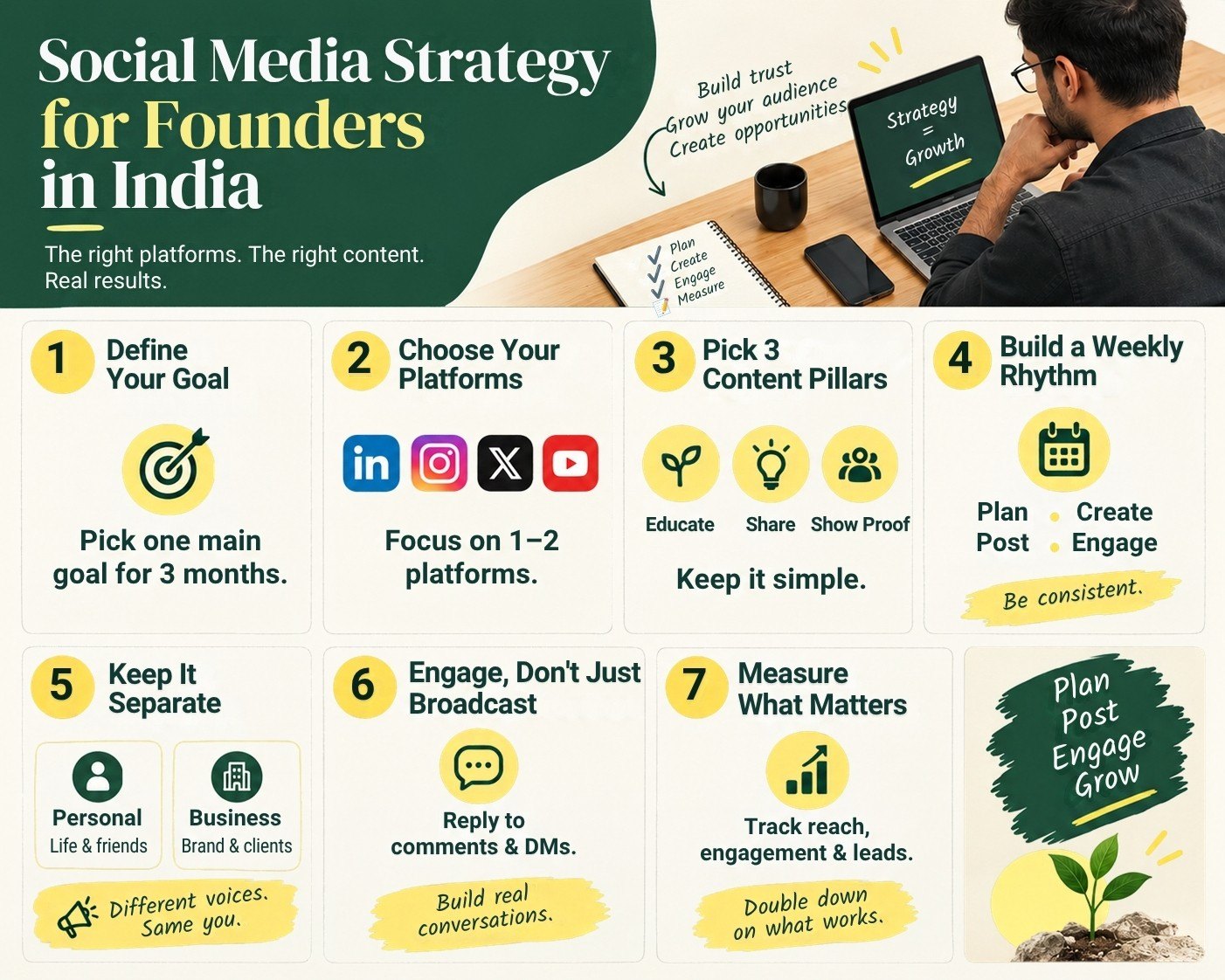
    Infographic showing the 7 steps of a social media strategy for founders in India, from setting a goal to measuring results

    Why founders need a social media strategy of their own

    People connect with people far more easily than they connect with logos. A founder who shares how they think, what they are building and what they have learned gives customers, investors and future hires a reason to trust the brand before they ever speak to anyone.

    That trust has real uses. It brings in enquiries, makes hiring easier, opens doors to journalists and helps investors feel they already know you. But it only works when it is planned. Random posting, however well meant, rarely builds anything.

    Step 1: Decide what you want social media to do for you

    Pick one main goal for the next three months. It could be:

    • Getting more customers or enquiries
    • Attracting good people to work with you
    • Building credibility with investors or partners
    • Getting noticed by journalists and industry events

    You can benefit from all of these over time, but your first goal decides what you post and where. A founder who wants B2B leads posts very differently from one who wants to sell a consumer product.

    Step 2: Choose one or two platforms, not five

    Trying to be everywhere is the fastest way to burn out. Match the platform to your goal and your audience:

    • LinkedIn: best for B2B, hiring, investors and professional credibility
    • Instagram: best for consumer brands, visual products and behind-the-scenes stories
    • X: useful for startup, tech and media communities that talk in real time
    • YouTube: strong for long-form explanations and building depth over time

    Start with one platform and do it well for at least three months before adding another.

    Step 3: Pick three content pillars

    Content pillars are the three topics you come back to again and again. They remove the daily “what do I post” problem. A simple set for founders:

    • The building story: decisions, mistakes, milestones and what you are learning
    • Your expertise: practical lessons from your industry that help your audience
    • Proof: customer stories, results and real moments from the business

    Mix these through the week so your profile feels useful and human, not only promotional.

    Step 4: Build a weekly rhythm you can keep

    Consistency beats intensity. Three good posts a week that you can sustain are better than a daily burst that stops after a month. A simple routine:

    • Set aside one block each week to plan and write the week’s posts
    • Keep a running note of ideas from meetings, customer calls and conversations
    • Batch your writing so posting never depends on your mood that day

    Step 5: Run your personal profile and company page differently

    Your personal profile and your company page do different jobs. The personal profile is where trust and conversation happen. The company page is the official home for announcements, hiring and proof. Make sure both tell the same story, but let the founder profile carry the voice.

    Step 6: Engage, don’t just broadcast

    Posting is half the work. Reply to every comment in the first few hours. Comment thoughtfully on posts by people in your industry. Reply to DMs even if the answer is short. Most of the opportunities that come from social media start in the comments and inbox, not in the post itself.

    Step 7: Measure what matters

    Likes feel good but they rarely pay the bills. Track the signals that connect to your goal: enquiries, DMs from the right people, profile visits, mentions from journalists, and applications for open roles. Review them once a month and double down on the content that brings them.

    Common mistakes founders make on social media

    • Being on every platform at once. Spread thin, nothing gets the attention it needs.
    • Only posting when there is good news. An audience that only hears announcements stops listening.
    • Sounding like a press release. People follow founders for their point of view, not for corporate language.
    • Ignoring comments and messages. It quietly tells people no one is really there.
    • Quitting too early. Most profiles need months of steady posting before results show up.
    • Copying someone else’s voice. What works for another founder rarely works unchanged for you.

    Infographic showing the 7 steps of a social media strategy for founders in India, from setting a goal to measuring results

    How Sorta Famous helps founders with social media

    Sorta Famous is a Mumbai-based PR and marketing agency that helps founders and brands build visibility that lasts. All of our engagements start with an in-depth audit of your current presence and goals, followed by a content and media strategy built around your calendar and not a generic content plan. We also give project-based support without a long-term retainer, for founders who need a focused push around a launch or milestone. And there are no account managers in between. You work directly with the strategists running your campaign.

    To start building a social media presence with a strategy behind it, get in touch with Sorta Famous for a free 30-minute consult.

    Frequently asked questions

    Which social media platform is best for founders in India?

    It depends on your goal. LinkedIn works best for B2B, hiring and investor credibility, while Instagram suits consumer brands and visual products. Start with one and add more only when the first one is running smoothly.

    How often should a founder post on social media?

    Three times a week is a realistic starting point for most founders. It is better to post at a pace you can keep for months than to go daily and stop.

    Should a founder post as themselves or as the company?

    Both, with different roles. The personal profile carries the voice and builds trust, while the company page handles official updates, hiring and proof.

    How long does it take for founder social media to show results?

    Usually a few months of steady posting. Early results often show up as better conversations and DMs before they show up as numbers.

    Do I need to show my face and share personal stories?

    Not necessarily. You can lead with your expertise and the story of the business. Share only what you are comfortable with, as long as the voice feels real.

    Can I hand over my social media to someone else?

    Yes, in part. A team can plan, draft and schedule content, but the ideas and opinions should come from you. The strongest founder profiles are built on the founder’s real point of view.
  • How to do PR for a startup in India

    How to do PR for a startup in India

    Most founders think PR is something you do after you raise a round or hit a big milestone. By then, the story has usually been told by someone else, or by no one at all. A startup that starts early gets something money can’t buy: third-party credibility. When a journalist writes about you, customers, investors and future hires believe it far more than anything on your own website.

    Here is a practical guide on how to do PR for a startup in India, even if you don’t have a big budget or a big team yet.

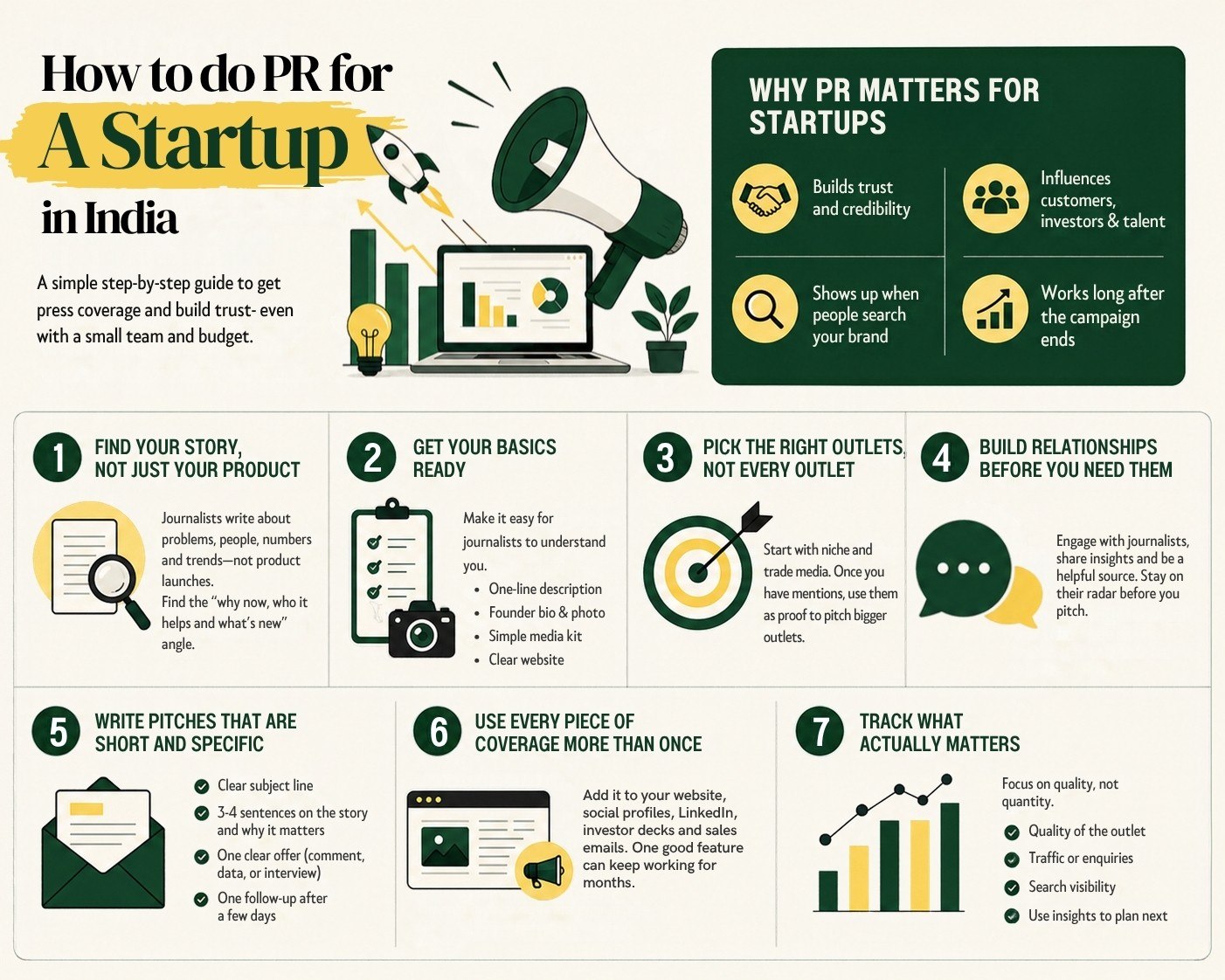
    Infographic showing the 7 steps of how to do PR for a startup in India, from finding your story to tracking results

    Why PR matters for startups in India

    Indian startups are fighting for attention in every sector at once: fintech, D2C, SaaS, food, fashion and more. Paid ads buy you attention for as long as you keep paying. Press coverage keeps working after the campaign ends. It shows up when someone googles your name, when an investor does their homework, and when a candidate checks you out before accepting an offer.

    There is also a trust gap that every new brand has to cross. People don’t know you yet, so they look for signs that someone credible already does. A feature in a respected publication is exactly that sign.

    Step 1: Find your story, not just your product

    Journalists don’t write about “we launched a new app”. They write about a problem, a person, a number or a trend. Before you pitch anyone, ask yourself:

    • Why is this happening now?
    • Who does it help, and how?
    • What is surprising or new about it?

    Good angles for startups include the founder’s journey, a data point from your own customers, a trend your startup sits inside, a local angle tied to your city or state, or a clear milestone like your first 1,000 customers.

    Step 2: Get your basics ready before you pitch

    The first thing a journalist does after reading your pitch is Google you. Make sure what they find is clear:

    • A one-line description of what you do, in plain words
    • A short founder bio with a good photo
    • A simple media kit with your logo, product images and key facts
    • A website that explains your business without jargon

    If a journalist can’t understand what you do in thirty seconds, the pitch usually ends there.

    Step 3: Pick the right outlets, not every outlet

    Think in three tiers: national business and lifestyle outlets, trade and industry publications, and regional or city-focused media. Most startups should begin with trade and niche publications. Your story is a better fit there and the competition for space is lower. Once you have a few mentions, you can use them as proof when you pitch bigger outlets.

    Step 4: Build relationships before you need them

    Follow the journalists who cover your sector. Read what they write, share it, and respond thoughtfully. Offer yourself as a source for quotes on industry trends. This is often easier than landing a full feature, and it puts your name in front of the right people so that your pitch is not a cold email when the time comes.

    Step 5: Write pitches that are short and specific

    A good pitch is easy to say yes to. Keep it simple:

    • A subject line that says what the story is
    • Three or four sentences on the story and why it matters to that outlet’s readers
    • One clear offer, such as founder availability for comment or data you can share
    • A single follow-up after a few days, not daily nudges

    Step 6: Use every piece of coverage more than once

    Earned coverage is only useful if people see it. Add an “as featured in” line to your website, pin it on your social profiles, share it on LinkedIn, and include it in investor decks and sales emails. One good feature, used well, keeps working for months.

    Step 7: Track what actually matters

    The number of mentions is the least useful measure. Look at the quality of the outlet, whether it brought visits or enquiries to your website, and whether it now shows up when someone searches your brand name. Use this to decide where to focus next.

    Startup founder reviewing press coverage for their company, representing PR for startups in India

    Common mistakes startups make with PR

    • Pitching a product launch instead of a story. A launch is news only to you. Find the angle that matters to the reader.
    • Sending one mass email to every journalist. It is easy to spot and easy to ignore.
    • Waiting for a funding announcement. Founder stories, customer data and trends are all strong stories without a round attached.
    • Treating paid posts as earned coverage. Readers, search engines and investors can tell the difference.
    • Having a weak website when journalists look you up. The pitch can be great and still fail at this step.
    • Expecting results from a single pitch. PR builds through steady, relevant effort over months.

    How Sorta Famous helps startups with PR

    Sorta Famous is a Mumbai-based PR and marketing agency that helps founders and brands build credible visibility. All of our engagements start with an in-depth audit of your current visibility and goals, followed by a media strategy built around your calendar and not a generic content plan. We also give project-based support without a long-term retainer, for founders who need a focused push around a launch or milestone. And there are no account managers in between. You work directly with the strategists running your campaign.

    To start building press credibility for your startup, get in touch with Sorta Famous for a free 30-minute consult.

    Frequently asked questions

    How early should a startup start doing PR?

    As soon as you have a clear story, which is usually before launch or right after your first customers. Early PR builds a trail of credible mentions that makes later announcements easier to land.

    Can founders do PR themselves, or do they need an agency?

    Founders can handle the basics: sharpening the story, building a media list and sending pitches. An agency helps when you need existing journalist relationships, better timing and more of your own time back to run the business.

    What is the difference between PR and advertising for a startup?

    Advertising is paid and you control the message. PR earns coverage in outlets you don’t control, which carries more credibility. They work best together.

    How long does it take to see results from startup PR?

    It depends on what is newsworthy. A launch or milestone can move quickly, while steady coverage takes months to build. Think of PR as a long-term trust builder, not an overnight spike.

    Which outlets should an Indian startup target first?

    Start with trade and niche publications in your sector and city-focused business media. Then use that coverage as proof when you pitch larger national outlets.

    Can a startup get press coverage without funding news?

    Yes. Founder stories, customer data, industry trends and local angles can all make a strong story without any funding announcement.

    Is PR support available without a long-term retainer?

    Yes, with agencies that offer project-based engagements. It is worth asking about directly, especially if you only need support around a launch or milestone.

  • How to build a personal brand as a celebrity in India

    How to build a personal brand as a celebrity in India

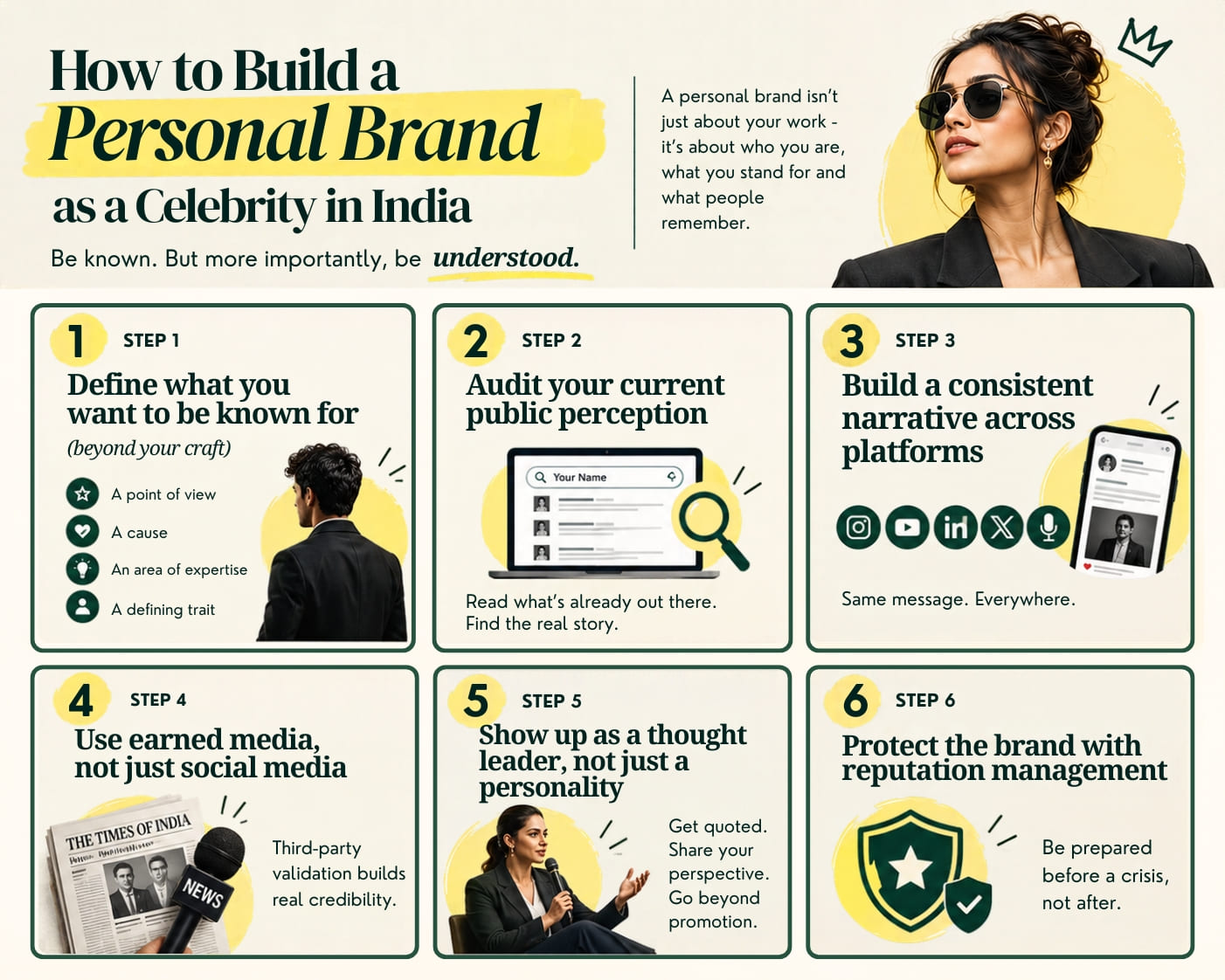
    There is a clear distinction between being known and being understood. Many actors, celebrities, singers in India have a lot of followers but no personal brand, as being followed says very little about who a person is. Personal brand is the difference between “I saw them in various shows” and “I completely get them”. The former becomes irrelevant with each new project, while the latter builds up over the years.

    Now, here is an actual guide on how to develop a personal brand, unlike the “be yourself” type of advice you will see all over the internet.

    Why personal branding matters more than ever for Indian celebrities

    The Indian entertainment industry has more entry points than ever before. From films to OTT to YouTube and podcasts, there has never been such fierce competition in all of them. One hit project used to be enough for a successful career for years. No more. The audiences and the brands today seek out celebrities with a personality, not necessarily a filmography.

    That is also why many celebrities seek new territories beyond acting or performing in any way. Personal brand building is key to make a credible step into entrepreneurship, health, investment, advocacy or anything else.

    Step 1: define what you want to be known for (beyond your craft)

    Before any press strategy or content plan, this has to be answered first: outside of acting, singing, or performing, what’s the thing people should associate with you? It could be a point of view, a cause, an area of expertise, or simply a consistent personality trait that comes through in every interview. Without this, every piece of press and content is disconnected from the last.

    Step 2: audit your current public perception

    Search your own name. Read what’s already been written. Look at your last ten interviews and ask what throughline actually exists in them. Most celebrities are surprised at how scattered their public image already is, a different angle in every piece, no consistent story tying it together. This audit is the starting point for everything that follows.

    Step 3: build a consistent narrative across every platform

    Once the positioning is clear, it has to show up the same way everywhere: interviews, social media bios and captions, LinkedIn if you’re building a business angle, even the questions you steer conversations toward on talk shows. Journalists and fans should be able to predict, in broad strokes, what you’re going to say about a topic before you say it. That predictability is what makes a brand feel real instead of manufactured.

    Step 4: use earned media, not just social media

    A personal Instagram post says what you want people to think. A feature in a national publication or a quote picked up by an entertainment desk carries far more weight, because it’s a third party validating the story, not just you telling it. This is where PR and personal branding intersect directly: press coverage, thought leadership pieces, and interviews are what turn a self-described identity into a publicly recognised one.

    Step 5: show up as a thought leader, not just a personality

    The celebrities who build the strongest personal brands eventually get quoted on topics outside their immediate work, industry trends, causes they care about, business decisions they’ve made. That only happens if you’re actively positioned for it: pitched for panels, approached for opinion pieces, made available for the kind of interview that goes beyond promotion.

    Step 6: protect the brand with reputation management

    A personal brand takes years to build and one bad news cycle to damage. Misquotes, out-of-context clips, and manufactured controversy move fast on social media. Part of building a personal brand is having a plan in place before any of that happens, not scrambling to respond after it’s already spread.

    build-celebrity-personal-brand-india

    Common mistakes Indian celebrities make with personal branding

    • Treating it as a social media task. Personal branding is a media and narrative strategy. Social content is one output of it, not the whole thing.
    • Changing the narrative every few months. Chasing whatever trend or cause is currently getting attention instead of staying consistent erodes credibility rather than building it.
    • Waiting until a crisis to think about reputation. By the time damage control is needed, it’s already reactive instead of planned.
    • Doing it without press support. Self-published content can only go so far. Third-party media coverage is what makes a personal brand credible rather than self-promotional.

    How Sorta Famous helps

    Sorta Famous helps actors, TV stars, musicians and entrepreneurs with personal brand building right from the start, by doing the positioning and audit work. This is followed by a media and content strategy that supports the chosen position. This includes media relations to secure the earned media that will provide credibility to your brand and reputation management to protect it. Assistance can be provided on ongoing or project basis, without having to sign a retainer agreement for years.

    To begin building your personal brand with a strategy behind it, contact Sorta Famous for a 30 minutes consultation.

    Frequently asked questions

    What does personal branding actually mean for a celebrity?

    That requires you to have a consistent identity in everything outside of your acting career, including media, interviews, and public appearances, which will help people and brands figure out who you are and what you are about, not just what shows you have been in.

    How is personal branding different from PR?

    PR is one of the tools used to build a personal brand. It covers the media relationships and press coverage that give a personal brand external credibility. Personal branding is the broader positioning and narrative strategy that PR, social media, and public appearances all support.

    How long does it take to build a recognisable personal brand?

    There is no fixed timeline, but it is a long-term effort. The positioning and audit work can be done in a few weeks, while consistent press coverage and a narrative people actually recognise usually take several months to a year or more of sustained work.

    Do I need to be a public figure already to start building a personal brand?

    No. In personal branding, timing matters greatly. It is important that personal branding happens right from the beginning because the brand would already be formed in the audience’s eyes in relation to the event or position that made the person well known.

    Can personal branding help with brand endorsements and business opportunities?

    Yes. Brands tend to opt for those personalities who have a distinct identity, for that adds credibility to the connection and lowers the chances of forming a mismatched one.

    What if I already have a strong following but no clear personal brand?

    This is true. In most cases, having a large following without a distinctive voice implies that the audience is familiar with the personality but not with what he or she stands for. An assessment of the brand perception of the celebrity is the starting point of solving the problem.

    Is personal branding just about looking good in the media?

    No. It is about maintaining consistency and having an actual point of view.

  • PR Agency for actors and celebrities in Mumbai: What it actually takes to stay in the news (and stay relevant)

    PR Agency for actors and celebrities in Mumbai: What it actually takes to stay in the news (and stay relevant)

    Mumbai doesn’t have a shortage of talent but the city of dreams surely runs on a shortage of attention. Every week, you see people walking into Jio Drive to catch a glimpse of a new film, or you spot a banner of a new show dropping on OTT as you make way from a jam packed Western express highway or you have a new face going viral on Instagram Reels as you scroll through your commute in Mumbai local.

    If you’re an actor, TV personality, singer, or public figure trying to be seen in all of this noise then talent alone won’t cut it. You need someone actively working the media on your behalf and that is where you need a PR agency for actors and celebrities in Mumbai.

    This isn’t about hiring someone to “post more” or “get you trending” there is more to it. It is about building a media presence that holds up over months and years (not just around a release date).

    Why actors and celebrities in Mumbai need a specialised PR agency

    Mumbai is the epicentre of Hindi film, television, and a growing chunk of India’s OTT and influencer economy with all of them competing for the same limited column inches and prime-time slots.

    A general marketing agency that’s used to running Instagram ads for a D2C brands doesn’t have entertainment desk contacts at India Today, Mid-Day, Firstpost, or Zoom. They don’t know which entertainment journalist covers Bollywood exclusives versus TV personalities versus regional music artists. And that layer of already established relationships is the entire value of an entertainment-focused PR agency.

    There is also a timing problem specific to this industry. A film promotion cycle, a show launch, or a single release has a narrow window where press interest is highest. Miss it and no amount of budget gets that coverage back. But a specialised agency plans around that calendar instead of reacting to it.

    What a PR agency for actors and celebrities actually does

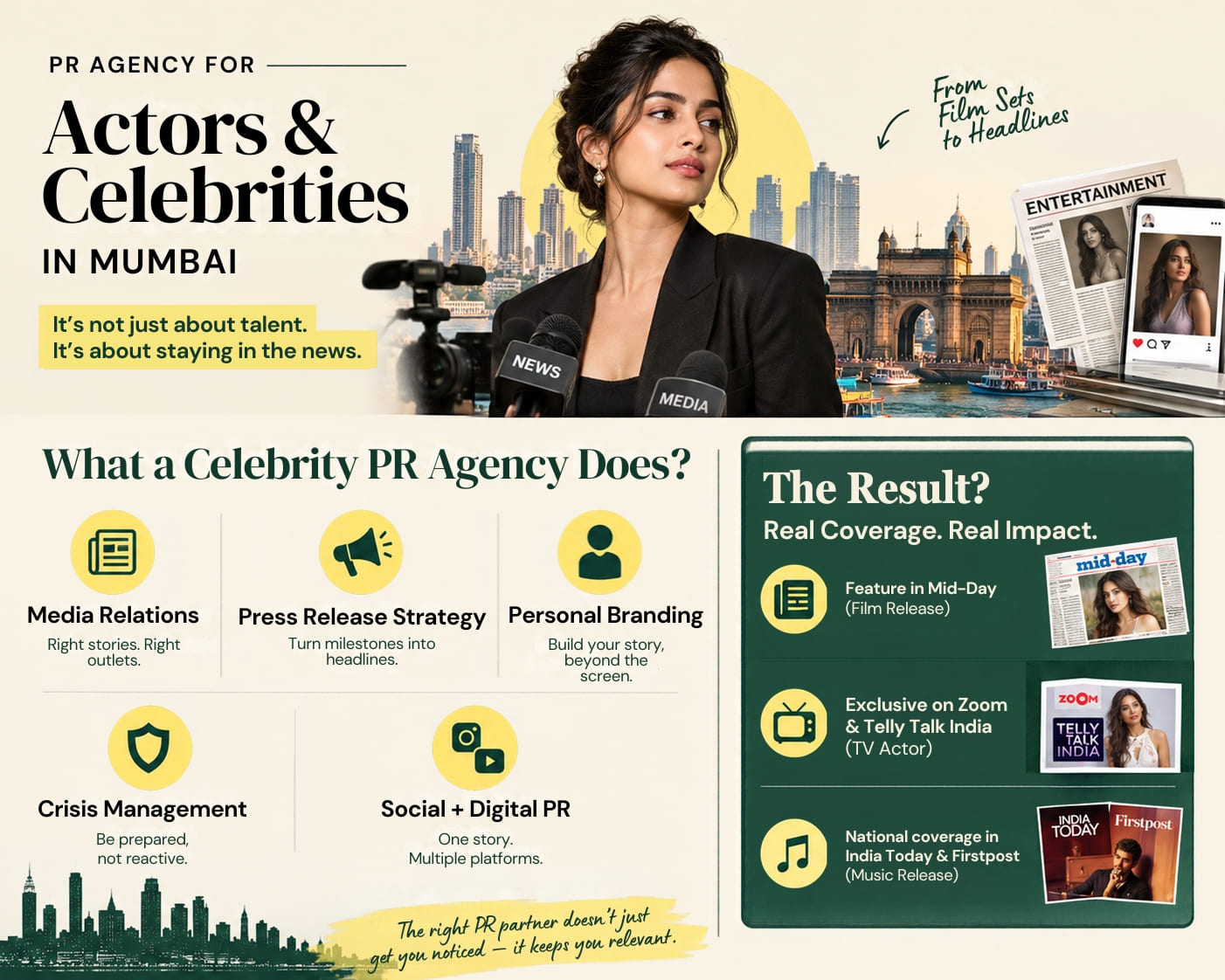
    Media relations and press placements

    This is the core of the job: building and maintaining relationships with entertainment journalists and editors so that when there is a story to tell, it lands with the right outlet instead of a mass, ignored email blast.

    Good media relations means a journalist already knows who you are before the agency even pitches because the relationship was built over time and not just before a release for some temporary screen time.

    Press release strategy around releases and milestones

    A film announcement, a show renewal, a music drop, a brand endorsement, an award nomination, these all need to be framed as a story and not just an announcement. Because stories connect and a well-timed press release tied to a release date does more for visibility than ten generic posts on your social handle.

    Personal branding beyond the screen

    Increasingly, an actor’s or celebrity’s career is shaped as much by how they’re perceived off-screen as on it.

    And that is where personal branding work comes in. Be it positioning someone as a voice on things beyond their roles or building out a LinkedIn/public presence if they’re moving into entrepreneurship or advocacy, all of this is done while making sure that their story is consistent across every platform a journalist or fan might check.

    Crisis management and reputation protection

    Not every story is one you pitch because in this industry controversy, misquotes, and viral misunderstandings move fast especially when you are a public figure. A good PR partner has a plan for damage control before it’s needed, not after.

    Social media and digital PR integration

    Traditional press coverage and social media aren’t separate tracks anymore. A feature in a national daily gets repurposed into a social post, a press mention gets pinned, an Instagram moment gets pitched to entertainment desks as a story.

    And this is where you need agencies that treat these as one connected system get more mileage out of every placement.

    What this looks like in practice

    The proof of a celebrity PR agency isn’t in what it promises but it is more in the placements that they have actually landed. A few examples of what that looks like:

    • Securing a feature in Mid-Day’s Sunday edition timed to build anticipation ahead of a major film release
    • Landing exclusive coverage on entertainment platforms like Zoom and Telly Talk India for a television actor’s ongoing work
    • Getting a music artist national coverage in outlets like India Today and Firstpost around a single’s release

    None of this happens through a single pitch email. Instead all of this is the result of an agency that understands the news cycle, knows which outlet is right for which kind of story and has editors who already trust the pitches coming from them.

    How to choose the right PR agency for your career

    If you’re an actor, TV personality, or public figure evaluating agencies in Mumbai, a few things separate the ones worth hiring from the ones that aren’t:

    • Actual entertainment media relationships, not just a generic media list bought off the internet
    • A personal branding component, not just reactive press release writing
    • Project-based or campaign-based options, so you’re not locked into a retainer if you only need support around a release window
    • Direct access to the people running your campaign, not a layer of account managers between you and the strategy
    • A track record of real, verifiable placements, in outlets relevant to your specific space (film press, TV press, music press, or lifestyle press)

    PR-Agency-Actors-Celebrities-Mumbai

    Why Sorta Famous

    Sorta Famous is a Mumbai-based PR and marketing agency built around exactly this kind of work.

    Your partner that looks out for media relations, press placements, personal branding, and reputation management for actors, TV personalities, musicians, and founders.

    At Sorta Famous, all of our engagements start with an in-depth audit of your current visibility and goals which is followed by a media strategy built around your calendar and in no way a generic content plan. We also give project-based support without a long-term retainer (for anyone who needs a focused push around a release or milestone rather than an ongoing arrangement). And there are no account managers in between. You work directly with the strategists running your campaign.

    If you’re ready to build visibility that outlasts a single release, get in touch with Sorta Famous for a free 30-minute consult.

    Frequently Asked Questions

    What does a PR agency for actors and celebrities actually do?

    It manages media relations, press placements, press releases, and personal branding on behalf of an actor or public figure, with the goal of building consistent, credible visibility rather than one-off attention around a single event.

    How is PR different from just hiring a social media manager?

    Social media management covers your own channels. PR covers earned media, meaning coverage in outlets and publications you don’t own or control, which carries more credibility and reach than a self-posted update.

    How much does celebrity PR cost in Mumbai?

    Pricing depends on scope, whether it’s an ongoing retainer or a one-time project around a specific release or milestone. Agencies that offer project-based pricing, rather than forcing a long-term retainer, are generally a better fit for actors who only need a focused push at certain points in the year.

    Do I need a PR agency if I already have a manager or agent?

    Often, yes. A manager typically handles bookings, negotiations, and career decisions. A PR agency focuses specifically on media relationships, press coverage, and public perception, which is a different skill set and requires different industry contacts.

    How soon can I expect press coverage after starting with an agency?

    This depends heavily on what’s newsworthy at the time. An agency working around an upcoming release or announcement can move faster than one starting with no immediate hook, which is why timing the start of a PR engagement around a release calendar matters.

    Can PR help actors and artists who aren’t already well known?

    Yes. In fact, this is often where PR has the most impact, since it’s the tool used to build initial visibility and credibility rather than just maintaining an existing profile.

    Is PR support available without a long-term retainer?

    Yes, with agencies that offer project-based engagements. This is worth asking about directly, since not every agency offers it, and it matters if you only need support around a specific release or campaign.

  • What are the 5 types of Social Media Marketing?

    What are the 5 types of Social Media Marketing?

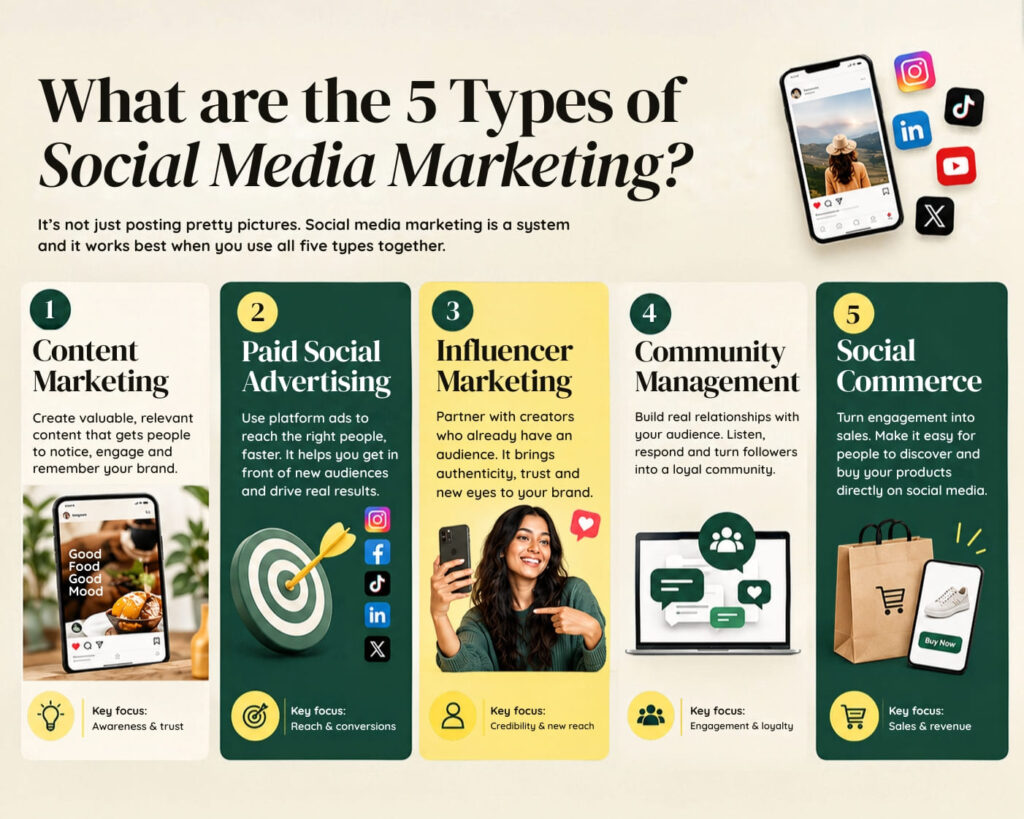
    The 5 types of social media marketing are content marketing, paid social advertising, influencer marketing, community management, and social commerce. Each one plays a different role. Some build awareness while some of them help you to drive sales. But for most brands to grow, they need to find a balanced mix of all five.

    A lot of people think social media marketing just means posting pretty pictures and hoping for likes. But that is just a very small piece of it. The brands that actually grow on social media treat it as a system and not as a hobby. And that is where you need professionals like Sorta Famous to come in and drive that balance for you.

    Each type below handles a different part of that system. Let’s break each one down properly, with real examples and how to actually start using each one.

    5 types of Social Media Marketing

    1. Content Marketing

    This is the type of marketing that most of the people will think of first as soon as they hear the word marketing. 

    Posting on Instagram, TikTok, LinkedIn, or X without paying to boost it.

    It includes photos, videos, memes, carousels, polls, whatever fits the platform and the need at hand. Herein the goal is simple, to get people to notice you and remember you before they eventually start to trust you.

    Duolingo is a great example of this. Their TikTok account barely talks about language learning. Instead, they post random skits with their owl mascot which gains them millions of views. Almost no direct selling. But everyone knows the brand now.

    Okay, I know what you’re thinking. “That’s great for a big company, what about a small business?”

    Content marketing actually works better for small businesses in some ways. You don’t need a huge budget but you need consistency and a clear idea of what your audience wants to see.

    Types of content that work well

    • Educational posts – teaching your audience something useful related to your niche
    • Behind the scenes content – showing how a product gets made or how your team works
    • Entertainment – memes, trends, humor related to your industry
    • User generated content – reposting what your customers already share about you
    • Short form video – still the strongest format across almost every platform right now

    How to actually start

    Pick one platform first. Many people/brands make mistake of trying to be everywhere at once. If your audience is mostly professionals, start with LinkedIn. If they’re younger and visual, start with Instagram or TikTok.

    Post consistently for at least 8 to 12 weeks before judging results. Growth on social media is rarely instant. 

    Most accounts that “blow up overnight” actually posted for months with small numbers before one post took off.

    2. Paid Social Advertising

    This is where you pay the platform to show your content to more people. Facebook Ads, Instagram Ads, TikTok Ads, LinkedIn Ads. You set a budget and pick your relevant audience after that the platform does the targeting.

    Why do brands use this? Because organic reach has dropped a lot over the years. Fewer people see your posts unless you pay them to (especially on Facebook and Instagram).

    Paid ads are useful for:

    • Promoting a specific product or sale
    • Retargeting people who visited your website
    • Growing followers fast
    • Testing which message converts best

    The catch is you need a clear goal before spending money because random boosted posts with no strategy usually end up wasting your budget.

    Types of paid social campaigns

    • Awareness campaigns – get your brand in front of new people, optimized for reach
    • Traffic campaigns – send people to your website or landing page
    • Conversion campaigns – optimized for actual purchases or signups, usually needs a pixel installed on your site
    • Retargeting campaigns – show ads only to people who already visited your site or engaged with your content

    A simple way to start with a small budget

    Start with $5 to $10 a day on one campaign and go on to test two or three different ad creatives against each other. Let it run for at least 3 to 5 days before making changes as your platforms need time to learn who responds best to your ad and switching things too fast ends up resetting that learning process.

    Track cost per result (not just likes and comments) as a post with 500 likes and zero sales isn’t actually performing well if your goal was sales.

    3. Influencer Marketing

    This means paying or partnering with someone who already has an audience to promote your product. Could be a huge celebrity with millions of followers or could also be a micro-influencer with 5,000 followers in a specific niche.

    Here’s something interesting. Smaller influencers often get better engagement rates than huge ones. A tech reviewer with 8,000 loyal followers might drive more real sales than a celebrity with 2 million, because their audience trusts them more.

    Influencer marketing works well for:

    • Product launches
    • Building trust in a new niche
    • Reaching an audience you can’t reach organically

    The key is picking influencers whose audience actually matches your product. 

    A fitness influencer promoting a random skincare brand rarely converts well if it feels forced.

    Different tiers of influencers

    • Nano influencers (1,000 to 10,000 followers) – highest trust, lowest cost, best for local or niche businesses
    • Micro influencers (10,000 to 100,000 followers) – still personal, decent reach, good balance of cost and results
    • Macro influencers (100,000 to 1 million followers) – wider reach, more polished content, higher cost
    • Celebrity influencers (1 million plus) – massive reach but usually low engagement rate and high cost

    How to find the right influencer

    Look past follower count. Check their comments section and not just the number of likes. 

    Real comments with actual questions or reactions matter more than a high like count with generic emoji comments which can be a sign of fake engagement.

    Ask for their engagement rate and average views if it’s not public. A creator with fewer followers but consistent views close to their follower count is usually more valuable than one with a huge follower count and low views.

    4. Community Management

    This is the type most brands ignore. Replying to comments. Answering DMs. Being present when people talk about your brand online.

    Wendy’s is famous for this on X (formerly Twitter). Their replies are witty, fast, and more importantly these days… human. People screenshot and share them which becomes free marketing on its own.

    Community management builds loyalty and moreover it also gives you direct feedback from real customers. If people keep asking the same question in your comments, that’s a sign to fix something on your website or add it to your FAQ.

    Last but not least, ignoring your comments and DMs sends a bad signal. It tells people nobody’s actually behind the account.

    What good community management actually looks like

    • Replying to comments within a few hours, not days
    • Answering DMs even when it’s a complaint, not just praise
    • Liking and responding to posts where people tag your brand
    • Joining relevant conversations in your niche, not just your own posts
    • Having an actual tone of voice instead of copy paste responses

    Why this type often gets skipped

    It’s time consuming and doesn’t show up on a graph the way follower count or ad spend does. But it’s often the reason people become repeat customers instead of one time buyers. Someone who gets a fast yet a helpful reply to a question is far more likely to trust the brand with their money.

    5. Social Commerce

    This is the newest type on this list. Selling directly through social media without sending people to a separate website.

    Instagram Shop, TikTok Shop, and Facebook Marketplace all let people buy without leaving the app. Fewer steps between seeing a product and buying it means fewer people drop off.

    Social commerce works especially well for:

    • Visual products like clothing, beauty, home decor
    • Impulse buys
    • Brands with strong short-form video content

    If your product is visual and your audience is already scrolling TikTok or Instagram, setting up a shop there removes a lot of friction from the buying process.

    Why social commerce is growing fast

    People used to see a product on social media, then open a browser, search for it, and buy it somewhere else. That’s three separate steps, and a lot of people drop off somewhere in between.

    Social commerce cuts that down to one step. See it, tap it, buy it. Platforms know this converts better, which is why they keep investing more into shop features every year.

    Getting started with social commerce

    Set up your shop catalog first, even if you’re not running ads yet. Tag products directly in your organic posts and videos. This turns every regular post into a potential sale, not just an ad.

    If you sell physical products and post video content already, this is usually the easiest type to add on top of what you’re already doing.

    How these 5 types work together

    types-of-social-media-marketing

    None of these five types work in isolation for very long and more important each of them support one another.

    Content marketing brings people in but community management keeps them engaged. Paid ads speed up growth once you know what content works but influencer marketing borrows trust from someone your audience already follows. And social commerce turns all that attention into actual sales.

    For example, a small business might post organic content for a few months and notice which posts get the most saves and shares then they put paid budget behind the best performing one. At the same time, they reply to every comment and DM which builds trust. 

    Once they have consistent content and a decent following, they add a shop feature to sell directly through their best performing posts.

    Common mistakes that brands make

    • Doing paid ads with no organic presence first. Ads work better when people can click on your profile and see real content already there.
    • Picking influencers based on follower count alone. Engagement and audience fit matter more.
    • Ignoring comments and DMs. This quietly kills trust over time.
    • Treating every platform the same way. What works on LinkedIn rarely works the same way on TikTok.
    • Giving up too early. Most accounts need consistent posting for months before results become visible.

    Tools that help with each type

    You don’t need a huge budget to manage all five types well. A few tools cover most of what you need.

    • Content marketing: Canva for graphics, CapCut for short form video editing, a simple content calendar in Notion or Google Sheets to plan posts ahead of time
    • Paid advertising: Meta Ads Manager and TikTok Ads Manager (both have built in analytics so you don’t need a separate tool when starting out)
    • Influencer marketing: platforms like Upfluence or simply searching hashtags and checking engagement manually for smaller budgets
    • Community management: most platforms have a native inbox but tools like Sprout Social or Buffer help when you’re managing comments across multiple accounts
    • Social commerce: Instagram Shop and TikTok Shop settings inside the app (no extra software needed to get started)

    Starting simple beats starting with ten different tools you never fully learn how to use.

    FAQs

    What is the most important type of social media marketing? There isn’t one type that works for everyone. Content marketing and community management are usually the best starting point since they cost the least and build the foundation for the other three.

    Do small businesses need all 5 types? No. Most small businesses start with content marketing and community management before they move into paid ads or influencer marketing once they understand their audience better.

    Which type of social media marketing gets the fastest results? Paid social advertising usually shows results the fastest since you’re paying for visibility directly. Content marketing and community management take longer but tend to build more long-term trust.